


Surge Protector vs. Voltage Protector: What’s the Difference? (Complete Guide)
Do you really need both a surge protector and a voltage protector in your distribution board? The short answer is: yes.
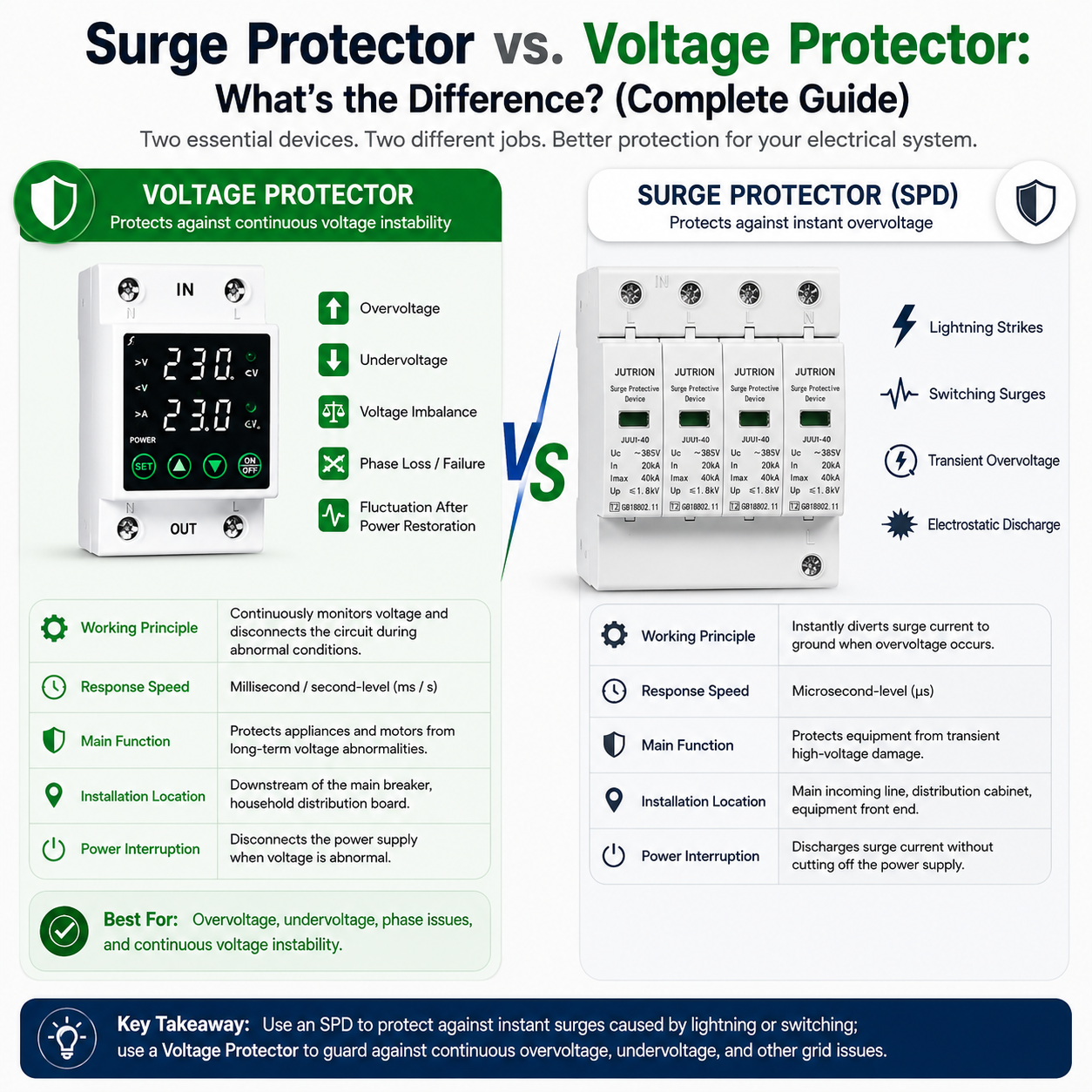
Although they look similar on a DIN rail, a surge protective device (SPD) is designed to handle instant lightning surges, while a voltage protector is used to deal with continuous grid voltage instability. This article will explain the differences between the two in detail.
Introduction to Surge Protective Devices (SPD)
A surge protective device, commonly abbreviated as SPD, is also known as a surge protector or lightning surge protector. It is a protective device used to limit transient overvoltage and discharge surge current. Its main function is to prevent instant high-voltage impacts caused by lightning induction, grid switching, electrostatic discharge, and other events from damaging electrical and electronic equipment.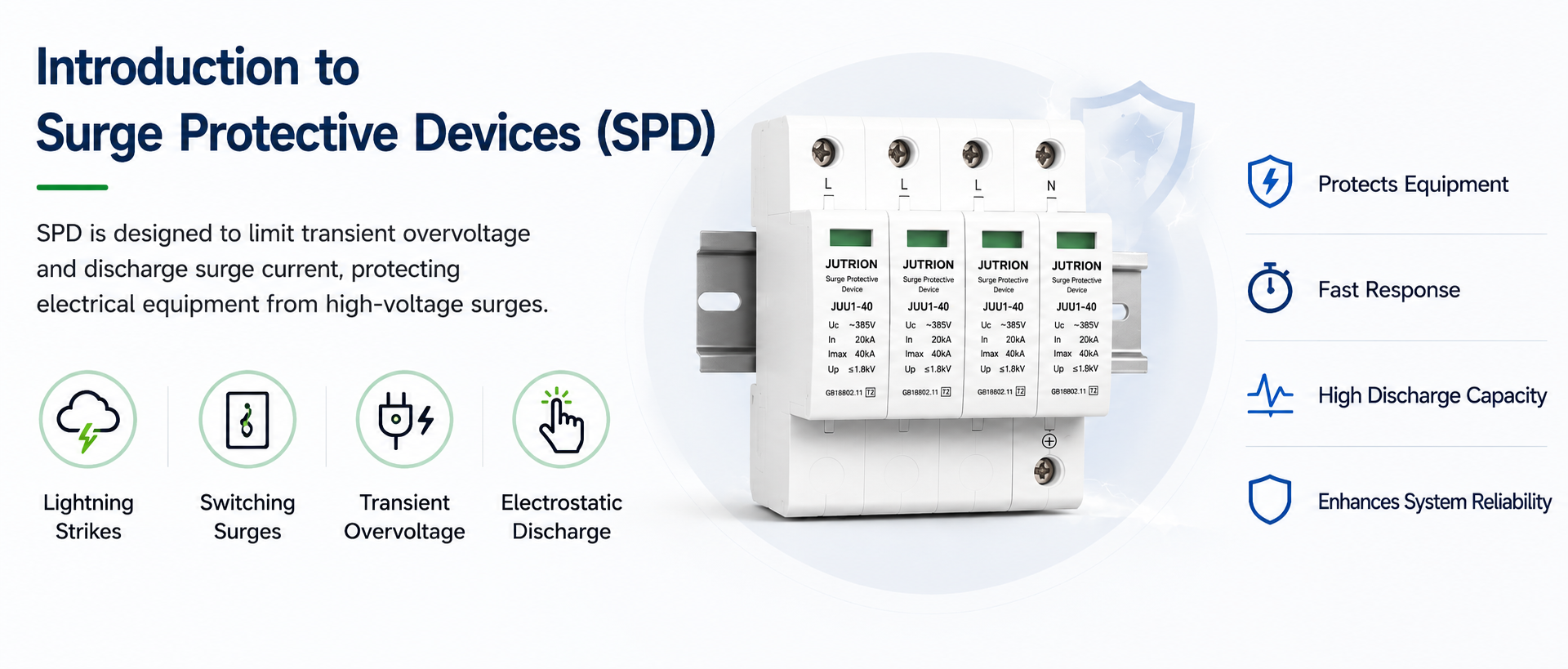
How Surge Protective Devices Work
- Normal condition: Under normal voltage, the internal nonlinear components, such as MOVs and GDTs, remain in a high-resistance state, similar to an open circuit, and do not affect normal circuit operation.
- Surge condition: When transient overvoltage exceeds the threshold, the components instantly switch to a low-resistance state, quickly diverting surge current to ground and clamping the voltage within the safe withstand range of the equipment, such as ≤1000V.
- After the surge disappears: The components automatically return to a high-resistance state, and the circuit resumes normal operation.
- Simple summary: Low voltage = high resistance; high voltage = low resistance; instant conduction and surge discharge.
Want to learn more about the basics of SPDs? Read our article: What Is a Surge Protective Device?
Introduction to Voltage Protectors
A voltage protector, also known as an overvoltage/undervoltage protector, is mainly used to monitor utility grid voltage. When the voltage is too high, too low, or unstable, it automatically disconnects the power supply. After the voltage returns to normal, it reconnects automatically after a time delay, thereby protecting low-voltage distribution systems and electrical equipment.
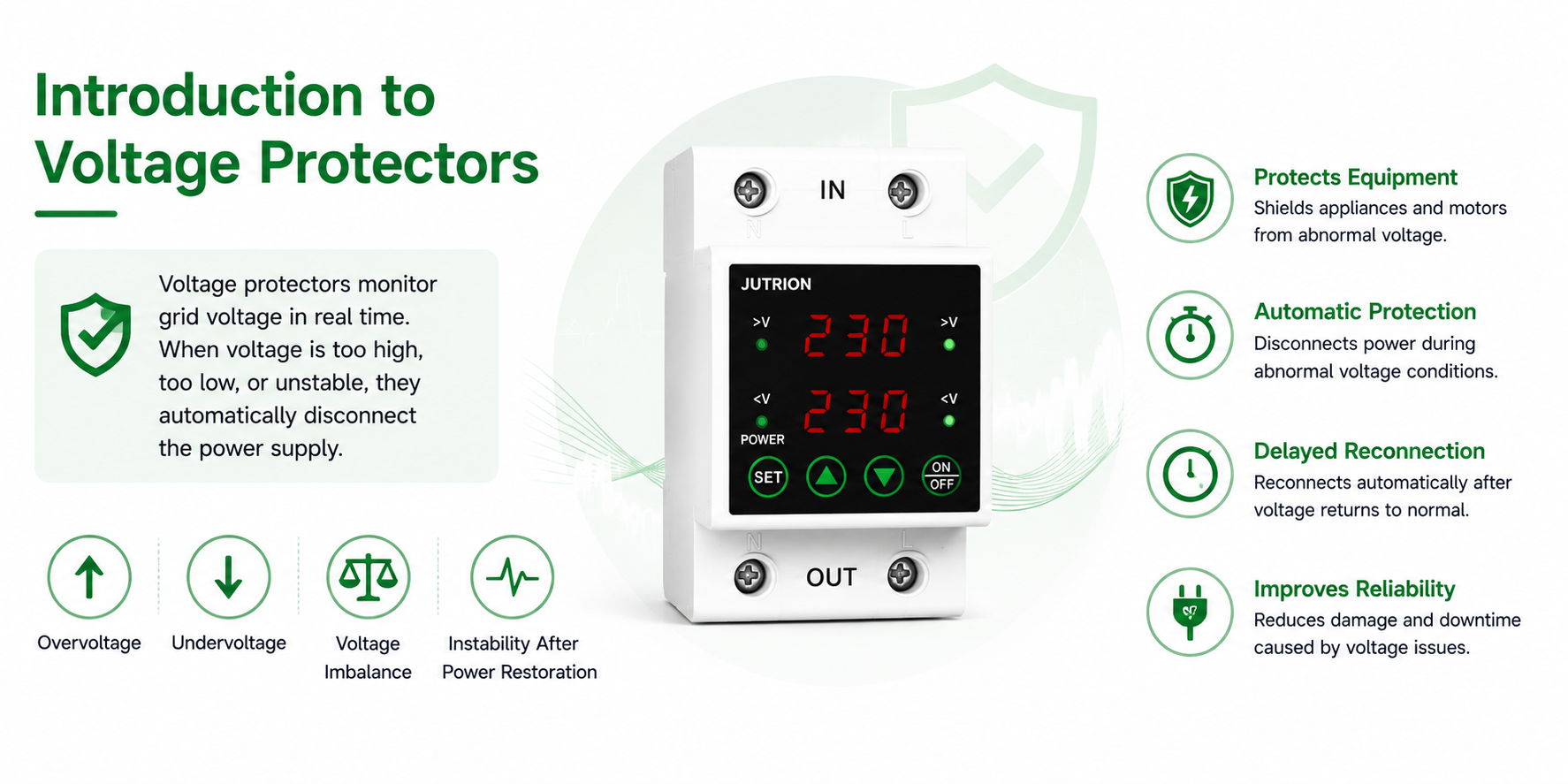
- Real-time accurate sampling: It continuously samples AC 220V/380V utility power in real time. After voltage division and conversion, it monitors grid voltage at high frequency, with a sampling accuracy of ±1% to ±2%.
- Threshold-based protection: In a single-phase system, the default overvoltage threshold is ≥250V and the undervoltage threshold is ≤170V. Once an abnormal voltage is detected, the device quickly disconnects the power supply, usually within ≤100ms for overvoltage and ≤500ms for undervoltage.
- Reliable contact separation: The internal relay disconnects the main circuit, completely isolating abnormal high or low voltage and preventing load equipment from being burned or damaged.
- Delayed stable reconnection: When the voltage falls back to 240V or rises back to the safe range of 180V, the device automatically reconnects after a default delay of 30–60 seconds, preventing repeated impacts on electrical appliances caused by grid fluctuations.
Want to learn more about voltage protection? Read our guide: What Is a Voltage Protector?
Surge Protector vs. Overvoltage and Undervoltage Protector: Feature Comparison
To help you avoid costly wiring mistakes and better protect critical electrical equipment, we have summarized a detailed comparison between surge protective devices (SPDs) and over/under voltage protectors below, making it easier to understand their different functions and applications in real-world electrical distribution systems.
Comparison Item | Surge Protector | Overvoltage and Undervoltage Protector (OVP/UVP) |
Protection Target | Lightning surges and transient overvoltage | Continuous overvoltage and undervoltage |
Working Principle | Instantly diverts surge current to ground during overvoltage events | Continuously monitors voltage and disconnects the circuit during abnormal conditions |
Response Speed | Microsecond-level response | Millisecond/second-level voltage monitoring |
Typical Fault Scenarios | Lightning strikes, switching surges, transient grid spikes | Grid instability, power restoration fluctuations, phase loss |
Operating Status | Normally remains in a high-resistance state without affecting the circuit | Remains connected during normal voltage and disconnects during abnormal voltage |
Main Function | Protects equipment from transient high-voltage damage | Protects appliances and motors from long-term voltage abnormalities |
Installation Location | Main incoming line, distribution cabinet, equipment front end | Downstream of the main breaker, household distribution board |
| Delay Function | No delay, instant surge response | Built-in delayed reconnection function |
Power Interruption | Discharges surge current without cutting off the power supply | Disconnects the power supply when voltage is abnormal |
When Do You Need a Surge Protective Device (SPD)?
A surge protective device (SPD) is specifically designed to handle transient, impulse-type electrical disturbances.
- Transient Overvoltage / Surge Current:
High-voltage spikes with an extremely short duration, usually lasting only from microseconds (μs) to milliseconds (ms). - Lightning-Induced Overvoltage:
Destructive impulses caused by direct lightning strikes, indirect/induced lightning, or ground potential rise (GPR). - Switching Overvoltage (Internal Surge):
Voltage spikes generated inside the power grid when interrupting large currents or switching heavy inductive/capacitive loads, such as starting or stopping large motors or transformers.1 - Electrostatic Discharge (ESD):
High-voltage impulses caused by electrostatic discharge
JUTRION Engineer’s Tip:If the overvoltage appears as a very short spike or impulse, it should be diverted by an SPD.
When Do You Need a Voltage Protector?
When the following continuous and stable voltage abnormalities occur, a voltage protector should be used:
- Overvoltage: The utility voltage continuously exceeds the rated value, such as long-term voltage above 250V in an AC 220V system.
- Undervoltage: The utility voltage continuously remains below the rated value, such as long-term voltage below 170V in an AC 220V system.
- Three-Phase Voltage Imbalance: The voltage deviation between phases in a three-phase system exceeds the allowable range.
- Phase Loss / Phase Failure: One phase in a three-phase system loses voltage or becomes severely undervoltage.
- Voltage Fluctuation After Power Restoration: The voltage becomes unstable and fluctuates repeatedly when power returns after an outage.
In short:
For continuous problems such as overvoltage, undervoltage, or phase loss, a voltage protector is used to disconnect the power supply and protect electrical equipment.
Recommended Protection Solutions for Different Applications:
Application | Recommended Protection | Why It Matters |
Residential Distribution Board | Type 2 AC SPD + Voltage Protector | Protects household appliances from lightning surges and unstable grid voltage. |
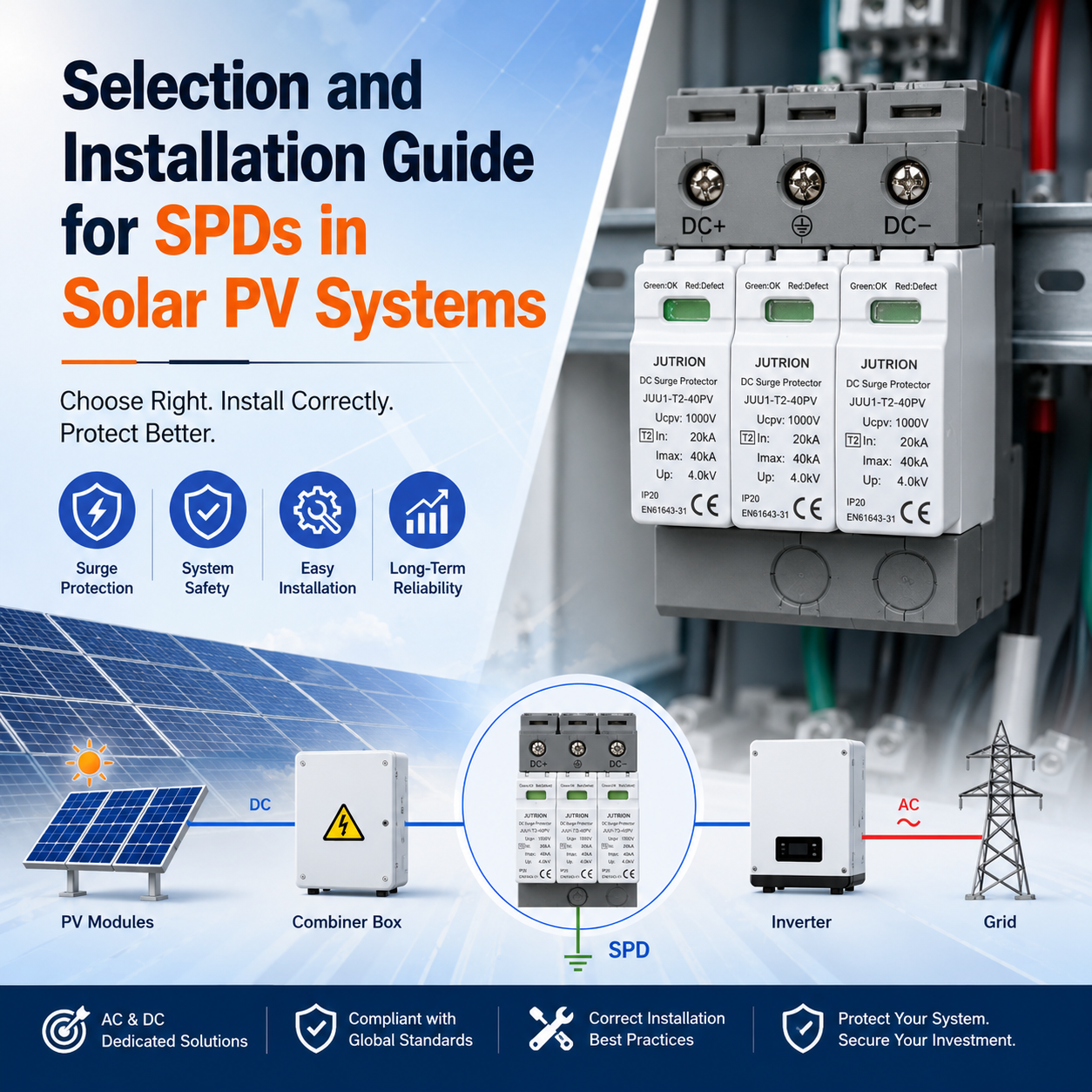
Solar PV Inverter System | DC SPD + AC SPD + Voltage Protector | Protects the inverter from both PV-side surges and grid-side voltage problems. |
Industrial Motor Control Panel | Voltage Protector + Phase Loss Protection + SPD | Prevents motor damage caused by phase loss, undervoltage, overvoltage, and switching surges. |
Data Center / Server Room | Type 1+2 SPD + UPS + Terminal Protection | Reduces downtime and protects sensitive servers from surge and voltage disturbances. |
Generator Backup Power System | ATS + SPD + Voltage Protector | Keeps backup power switching safe and protects equipment during generator start/stop. |
Commercial Building Main Panel | Type 1 or Type 1+2 SPD + Voltage Monitoring | Provides first-level protection for the whole building power distribution system. |
Final product selection must be based on the actual project conditions, including system voltage level, grounding system, lightning risk level, load characteristics,and installation environment. Key parameters such as discharge capacity, voltage protection level (Up), maximum continuous operating voltage (Uc), rated current, and protection mode should be carefully verified to avoid protection failure or equipment damage caused by improper selection.
Common Faults, Troubleshooting and Maintenance of Voltage Protectors
Normal voltage but no tripping
Cause:Voltage sampling component drift, internal parameter drift, loose wiring, electromagnetic interference.
Troubleshooting:Measure the incoming voltage and compare it with the set tripping value; tighten the incoming and outgoing terminals; keep the device away from interference sources such as inverters and contactors; recalibrate the protection voltage value.- Overvoltage / undervoltage protection does not operate
Cause:Damaged sampling circuit, control chip failure, actuator relay stuck.
Troubleshooting:Manually simulate high-voltage and low-voltage conditions to test the operation; check the power supply of the main PCB; replace the faulty relay; verify the operating voltage setting. - Unable to automatically reclose after tripping
Cause:Faulty delay circuit, recovery voltage set too high or too low, frequent voltage fluctuations.
Troubleshooting:Check the delay time parameter; measure the voltage within the recovery range; clean solder joints on the circuit board; adjust the reset voltage range. - No display or no operation after power-on
Cause:No incoming power, internal fuse blown, power supply circuit burned out.
Troubleshooting:Check whether the input power supply is energized; disassemble and inspect the built-in fuse; repair the internal stabilized power supply circuit. - Three-phase protector incorrectly detects phase loss / phase sequence
Cause:Three-phase voltage imbalance, loose incoming wires, abnormal sampling circuit.
Troubleshooting:Measure the three-phase voltages one by one; tighten the wiring terminals; adjust the sensitivity of the three-phase balance detection. - Overheating during operation, contact arcing
Cause:Load current exceeds the rated value, contacts are oxidized or burned, cable size is too small.
Troubleshooting:Check whether the rated current matches the load; polish or replace the moving and fixed contacts; replace the cable with a suitable specification.
Common Faults, Troubleshooting and Maintenance of Surge Protective Devices
Burned Housing or Damaged Module
Cause:Excessive lightning surge current, continuous power-frequency overvoltage passing through the varistor, long-term overload and aging.
Troubleshooting:Disconnect the power and remove the module to inspect the internal components; test the insulation resistance; replace the device directly. Do not continue using it.- Abnormal Indicator Status
Cause:Failure of the indicator mechanism, aging or deterioration of internal components, communication signal fault.
Troubleshooting:Check the product status marking; visually inspect the release structure; if there is no green normal indication, the SPD should be considered failed and replaced in time. - Large Leakage Current Causing Upstream Breaker Tripping
Cause:The varistor is damp, component aging causes leakage current to increase, or the wiring is incorrect.
Troubleshooting:Disconnect the power and measure the insulation between poles; clean moisture and dust; correct the wiring method; replace the SPD directly if aging is serious.
Loss of Protection After a Lightning Strike
Cause:Insufficient discharge current capacity, mismatched multi-level protection coordination, or the SPD had already failed but was not replaced.
Troubleshooting:Check whether the nominal discharge current matches the site conditions; inspect the upstream and downstream protection configuration; regularly replace expired products.Disconnector Trips or Pops Out
Cause:Internal components are thermally out of control, or continuous power-frequency current cannot be interrupted.
Troubleshooting:Immediately disconnect the power and remove the device; check whether the grid has long-term overvoltage; replace it with a new surge protective device of the same specification.
- Heating or Looseness at the Wiring Terminals
Cause:Loose terminal screws, undersized cable, or long-term heating caused by high discharge current.
Troubleshooting:Retighten the wiring terminals; select cables with a matching cross-sectional area; install and route the wiring according to standard requirements.
Core Summary of Surge Protectors and Voltage Protectors
These two devices are complementary and cannot replace each other in low-voltage distribution systems. Together, they build a complete electrical protection system covering both transient and steady-state voltage problems.
Surge Protective Device (SPD):
An SPD acts as an “instant high-voltage discharge shield.” With microsecond-level response, it diverts surge currents caused by lightning strikes, switching overvoltage, and other impulse events to ground, while clamping the voltage to a safe level. During the whole process, it does not disconnect the main circuit. It is designed to handle instant and sudden energy impacts, protecting sensitive equipment from high-voltage breakdown.
Voltage Protector / Overvoltage and Undervoltage Protector:
A voltage protector acts as a “continuous voltage circuit breaker.” With millisecond- or second-level response, it monitors utility voltage in real time. When steady-state voltage abnormalities such as overvoltage, undervoltage, or phase loss occur, it directly disconnects the circuit. After the voltage returns to normal, it automatically reconnects after a delay. It is designed to handle long-term and continuous grid instability, protecting household appliances and motors from being damaged by abnormal voltage.
When used together, they provide full-scenario protection from the incoming power line to the terminal loads, helping prevent electrical equipment from being damaged by different types of voltage-related faults.
-
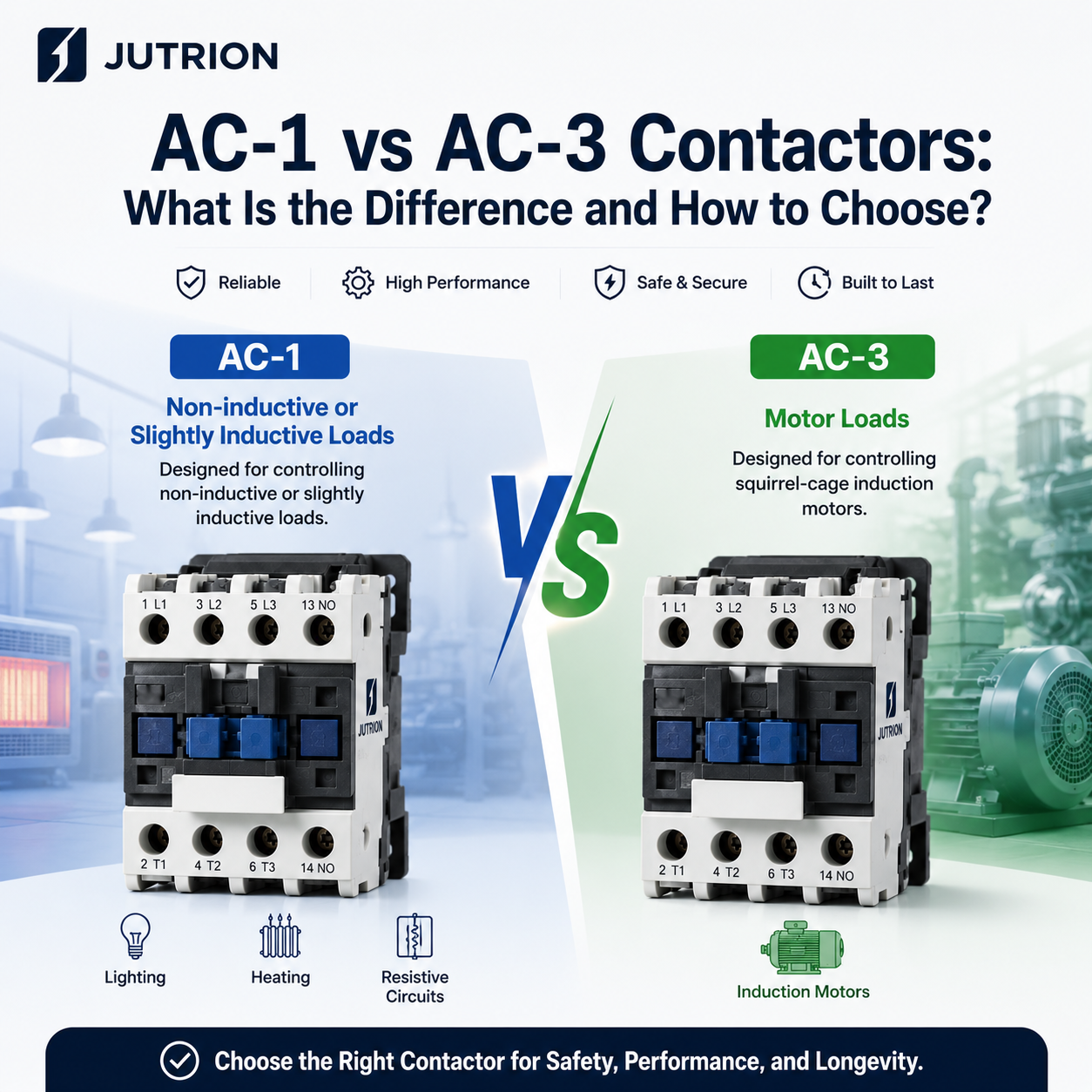
AC-1 vs AC-3 Contactors: What Is the Difference and How to Choose?
2026-05-20 19:31:24 -
Surge Protector vs. Voltage Protector: What’s the Difference? (Complete Guide)
2026-05-18 17:50:53 -
Selection and Installation Guide for SPDs in Solar PV Systems
2026-05-16 12:54:43 -
Voltage Stabilizer vs. Over and Under Voltage Protector: What Is the Difference?
2026-05-14 14:37:10 -
Confused by Icu, Ics and Icw? A Complete Guide to Understanding MCCB Nameplate Ratings
2026-05-12 17:31:01