


Over/Under Voltage Protector: Working Principle, Functions, and Wiring Guide
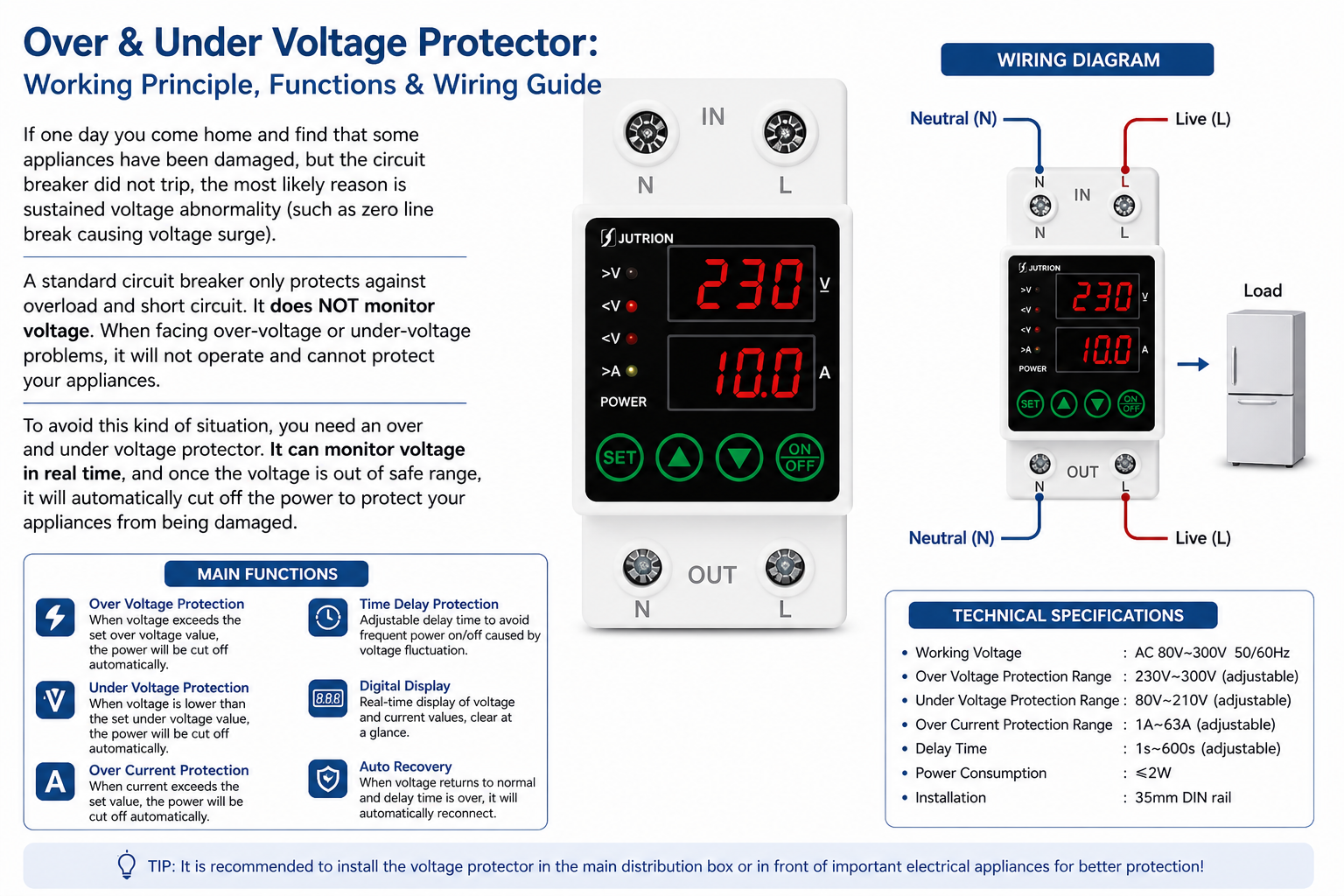
If you ever come home to find your appliances burnt out, but notice that the circuit breaker hasn't tripped, it is highly likely due to a sustained voltage abnormality (such as a sudden voltage surge caused by a broken neutral wire). Ordinary circuit breakers only protect against overload currents and short circuits. They do not monitor voltage levels at all. When faced with over-voltage or under-voltage issues, they will not trip, leaving your home appliances completely unprotected.
To prevent this from happening, you need an over/under voltage protector. It monitors the voltage in real-time and will automatically cut off the power supply the moment the voltage exceeds the safe range, effectively preventing voltage anomalies from destroying your electrical equipment at the source
If you want to learn more about the technical specifications, voltage protection range, current rating, and wiring details, you can check the detailed parameters of the JU6D over/under voltage protector.
Key Takeaways:
Get a clear understanding of exactly how an over/under voltage protector works.
Discover the mechanisms behind how it safeguards your electrical appliances.
Learn why over/under voltage protectors are essential in these specific application scenarios.
Master the wiring process, along with crucial post-installation inspections and troubleshooting techniques.
How Does an Over/Under Voltage Protector Work?
The first step is real-time voltage sampling and monitoring. The internal voltage detection circuit (typically comprising a voltage divider and a voltage sampling chip) continuously collects the incoming mains voltage signal. It converts the 220V high-voltage power into a low-voltage signal and transmits it to the control unit for processing.
The control unit then compares this sampled voltage against the internal preset thresholds, such as an over-voltage threshold (e.g., 275V±5V) and an under-voltage threshold (e.g., 165V±5V). To prevent false tripping caused by transient voltage spikes from lightning strikes or grid fluctuations, the device incorporates an action delay mechanism (typically 1 to 3 seconds).
Once a genuine fault is confirmed, the control unit drives the internal relay or contactor to swiftly cut off the main circuit. Simultaneously, the indicator lights on the front panel will display the corresponding fault status.
Even after the power is disconnected, the protector's voltage detection circuit remains active. It continuously monitors the mains to check if the voltage has returned to the normal operating range (usually 180V-250V).
Once the voltage stabilizes, the protector initiates a reset delay. This prevents the unstable voltage fluctuations that often occur right after power restoration from causing secondary damage to appliances. After the delay period finishes, the protector automatically closes the circuit, restores the power supply, and returns to its normal monitoring state.
Core Features
Visual real-time voltage display
Adjustable over/under voltage protection thresholds
Adjustable fault action delay and auto-reset delay
Automatic power cut-off protection during voltage anomalies
Automatic reset and power restoration when voltage returns to normal
Standard DIN-rail mounting, compatible with household distribution boxes, construction sites, and equipment cabinets.
Application Scenarios of Over/Under Voltage Protectors
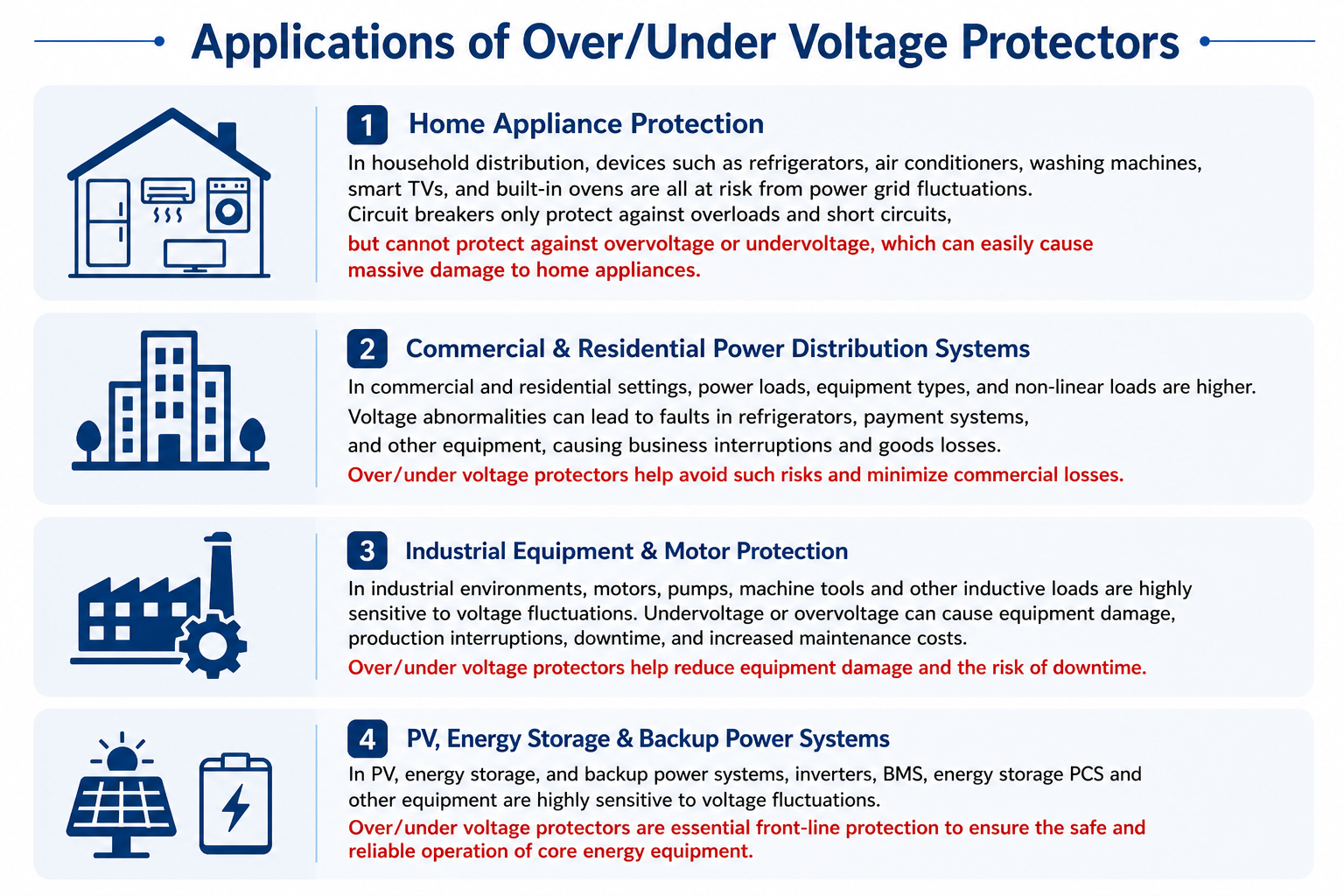
1. Home Appliance ProtectionIn residential power distribution, appliances such as refrigerators, air conditioners, washing machines, smart TVs, and built-in ovens are directly exposed to the risks of mains voltage fluctuations. Ordinary circuit breakers only trip during overloads and short circuits; they offer absolutely no voltage protection. They do not respond to over-voltage or under-voltage at all, which can easily lead to the mass burnout of household appliances.
2. Commercial Power Distribution SystemsThe electrical loads, equipment types, and requirements for unattended operation in commercial environments are much more complex than in ordinary households, and the financial losses caused by voltage anomalies are far more direct. The role of the over/under voltage protector here upgrades from "appliance protection" to "business continuity assurance," preventing business interruptions and inventory losses caused by failures in commercial freezers or POS (Point of Sale) systems.
3. Industrial Equipment and Motor ProtectionIn industrial settings, inductive load equipment such as motors, water pumps, and machine tools are extremely sensitive to voltage fluctuations. Over-voltage and under-voltage will not only damage the equipment but can also lead to production interruptions and downtime. The resulting financial losses often far exceed the maintenance costs of the equipment itself.
4. Photovoltaic, Energy Storage, and Backup Power SystemsIn PV, energy storage, and backup power systems, the voltage is inherently less stable than the municipal power grid. Fluctuations, voltage drifts, and switching surges are common occurrences. Meanwhile, equipment like inverters, BMS (Battery Management Systems), and energy storage PCS (Power Conversion Systems) are highly sensitive to voltage anomalies. Over/under voltage protectors serve as an indispensable front-line defense, preventing abnormal voltages from destroying these expensive new energy devices.
How to Wire an Over/Under Voltage Protector?
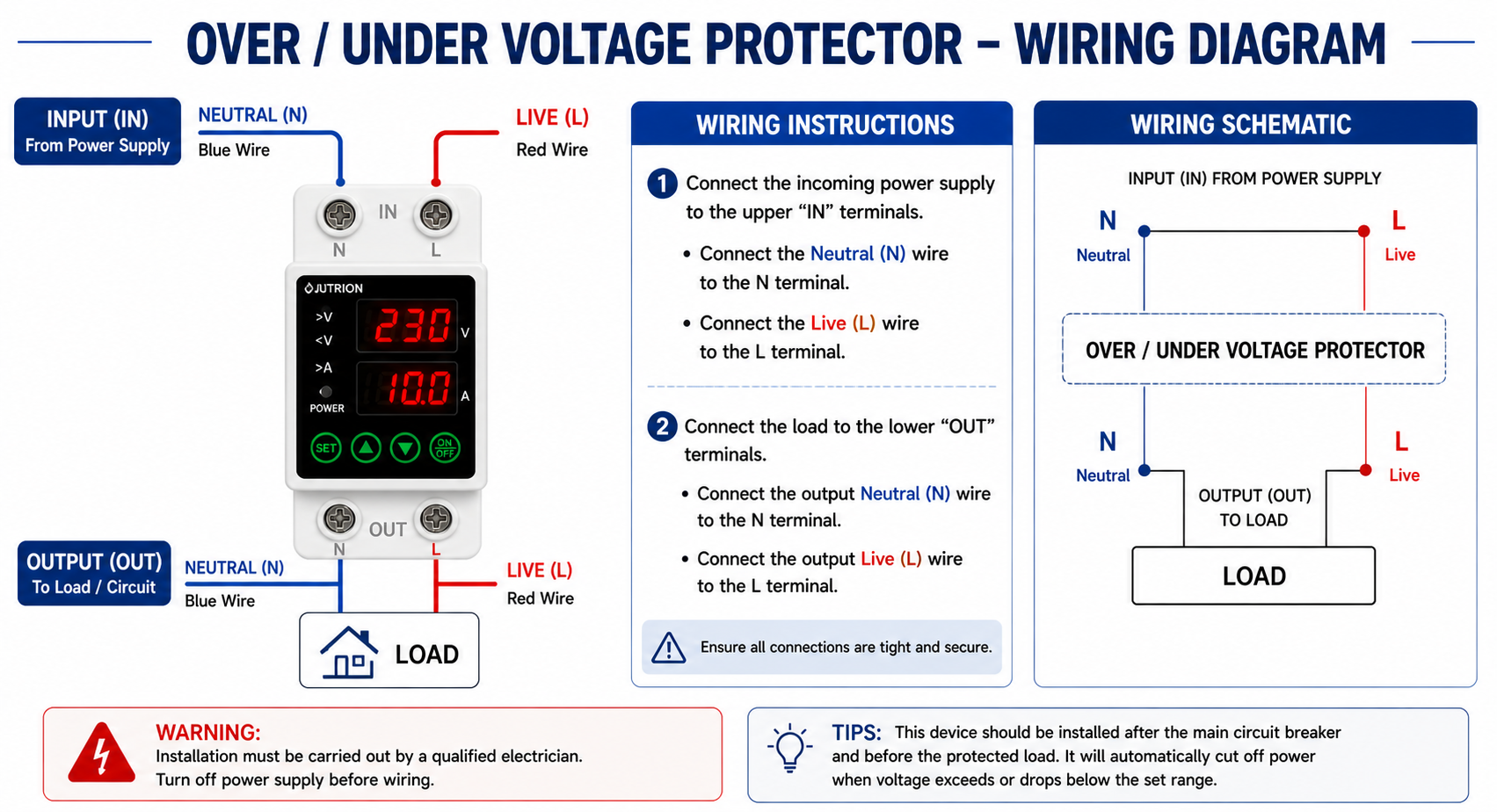
It must be installed after the main breaker and before the branch circuit breakers, serving as the first line of voltage defense for the entire power distribution system.
Power-On Testing:The power-on test for the over/under voltage protector involves first verifying that the wiring is completely correct. Then, by adjusting the parameters or simulating different voltage scenarios, you systematically verify whether its reconnecting (closing), tripping, and auto-reset functions operate properly under normal voltage, over-voltage, and under-voltage conditions.
Troubleshooting Table:
Symptom | Possible Cause | Troubleshooting Method |
No display or response after power-on | No incoming power / Loose wiring / Protector failure | Check the incoming voltage and wiring terminals; replace the protector for testing. |
Voltage is normal but fails to reconnect (close) | Reset delay not completed / Incorrect parameter settings / Internal failure | Wait for the delay to finish; check if the over/under voltage thresholds are set reversely; power off and restart to test. |
Frequent false tripping | Severe grid fluctuations / Protection thresholds set too narrow / Poor wiring contact | Adjust the action delay, widen the protection thresholds; check if the incoming terminals are securely tightened. |
Fails to reset after tripping | Voltage has not returned to the normal range / Reset delay set too long | Use a multimeter to measure the incoming voltage; check the reset delay parameters. |
Q:Can an over/under voltage protector replace a Miniature Circuit Breaker (MCB) or Residual Current Circuit Breaker (RCCB)?
A:No, their functions are entirely different. An MCB primarily protects against "overload and short circuits," while an RCCB is designed for "leakage protection and preventing electric shocks." Neither monitors the grid voltage levels. The over/under voltage protector is specifically designed to monitor "voltage anomalies." For comprehensive electrical safety, it must be used in conjunction with an MCB/RCCB and cannot replace them.
Q: Why does the protector wait a few minutes before restoring power after a power outage?
A: This is the normal "auto-reset delay" protection feature (typically set for 1 to 3 minutes). When power is first restored, the grid voltage is often highly unstable and prone to high-voltage surges or secondary outages. This delay ensures that the grid voltage has completely stabilized before safely supplying power to your appliances (especially refrigerator and AC compressors), preventing secondary damage from transient voltage shocks.
-
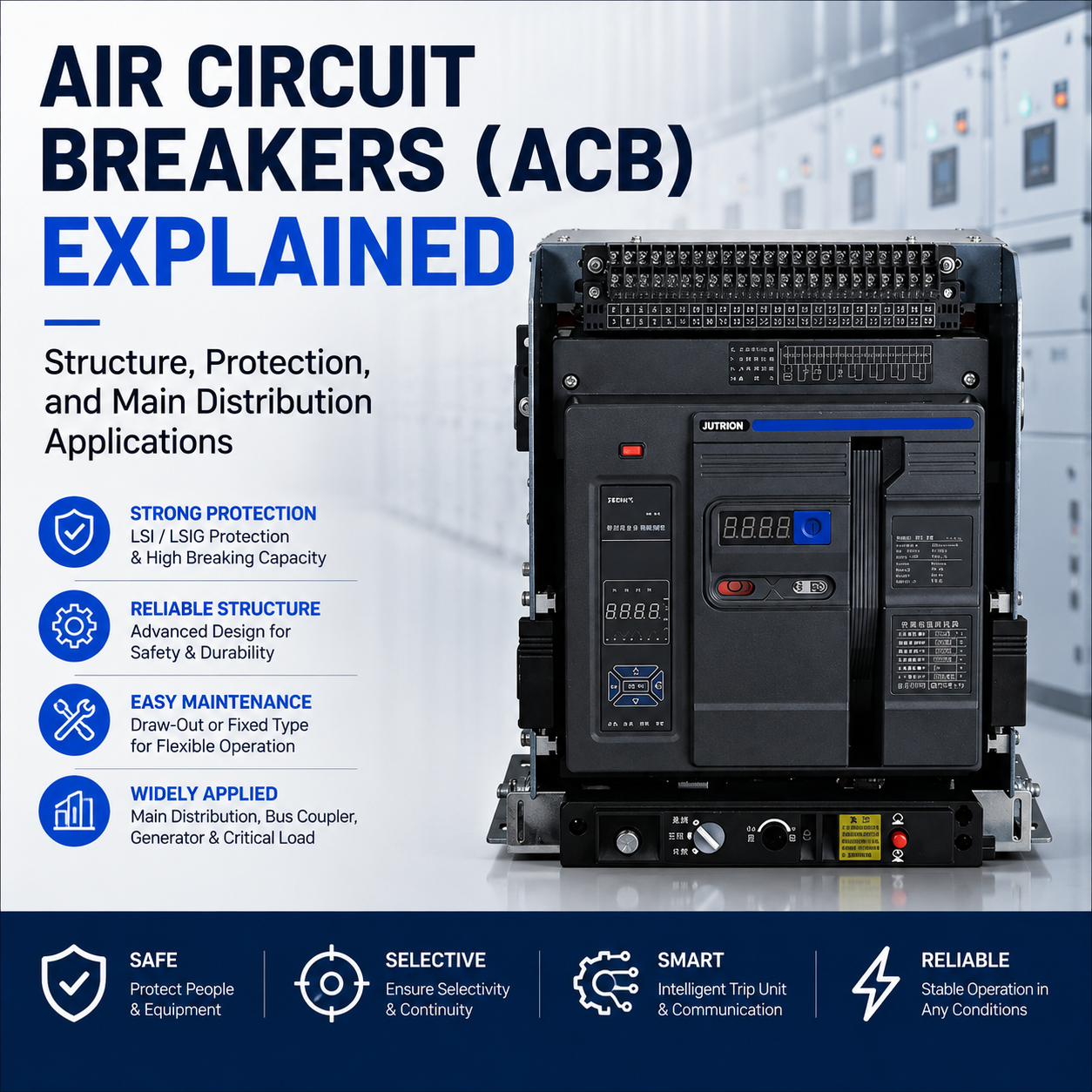
Air Circuit Breakers (ACB) Explained: Structure, Protection, and Main Distribution Applications
2026-05-24 22:21:27 -
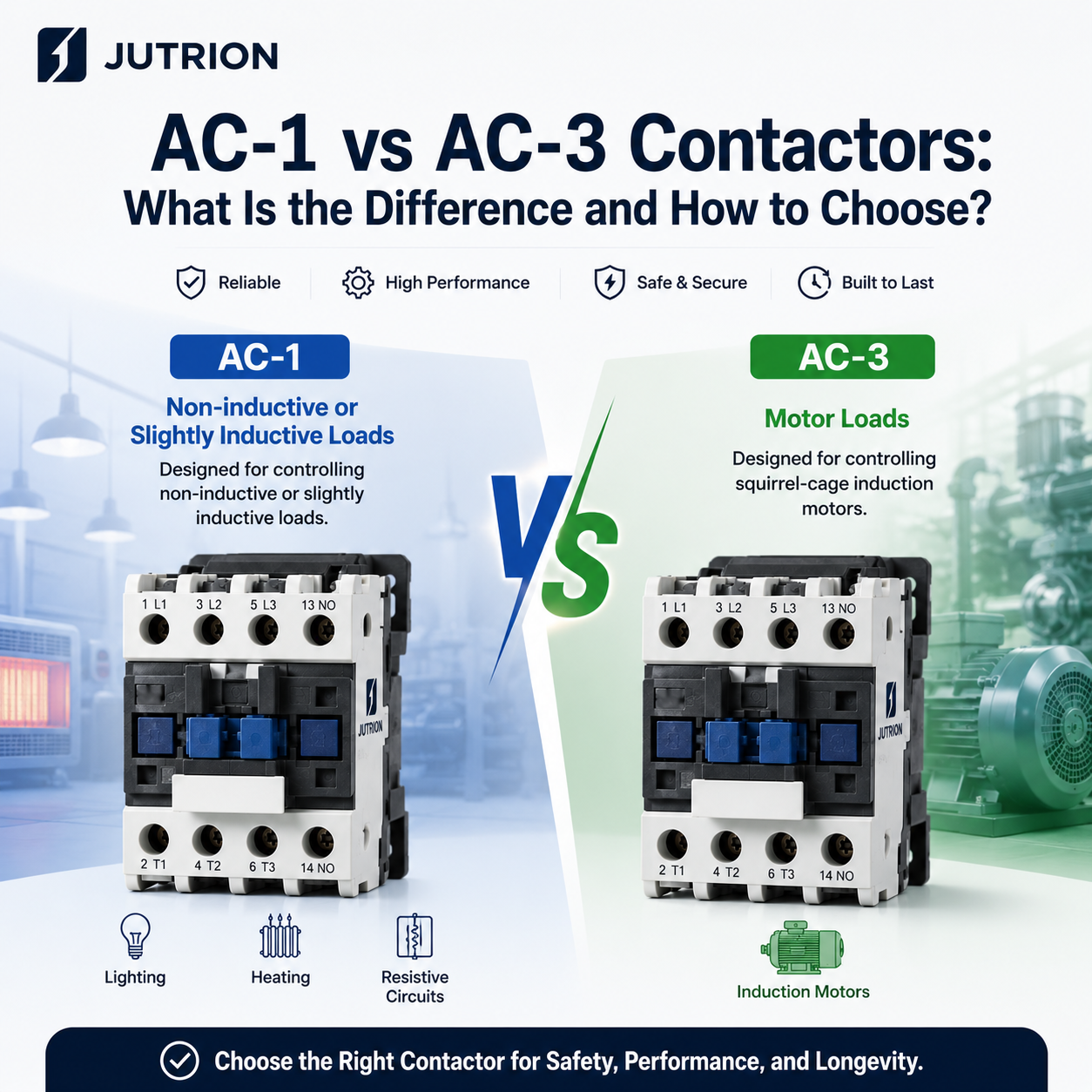
AC-1 vs AC-3 Contactors: What Is the Difference and How to Choose?
2026-05-20 19:31:24 -
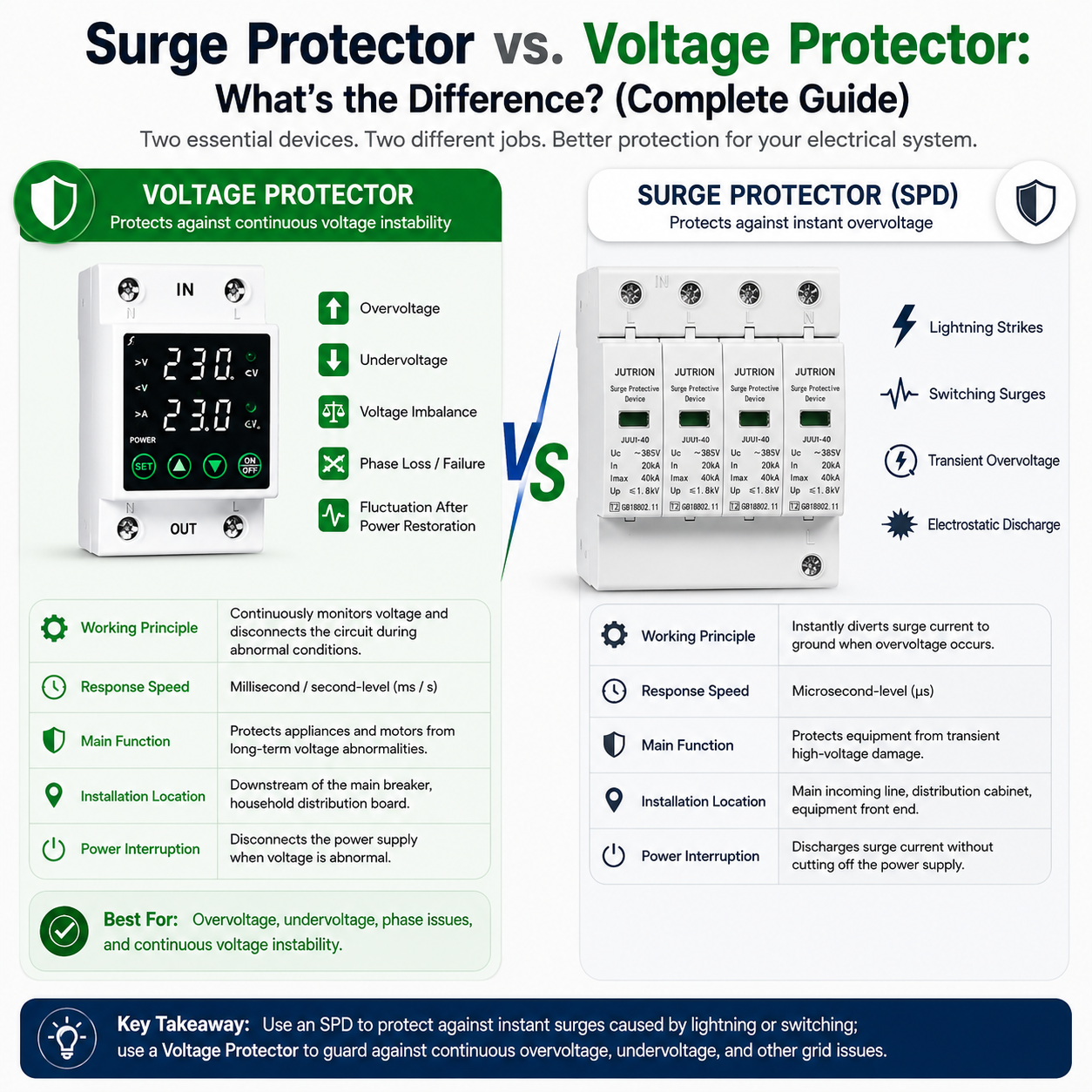
Surge Protector vs. Voltage Protector: What’s the Difference? (Complete Guide)
2026-05-18 17:50:53 -
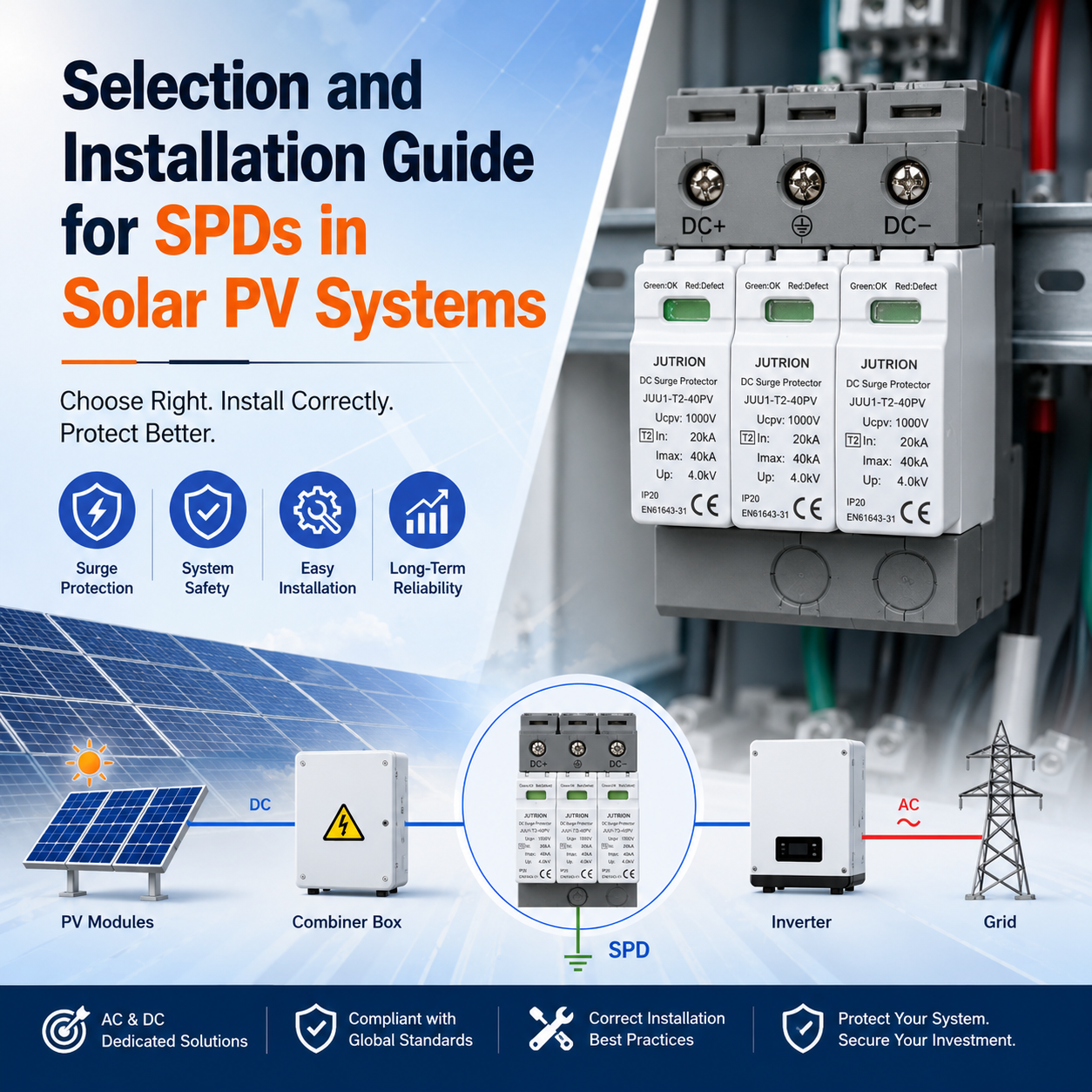
Selection and Installation Guide for SPDs in Solar PV Systems
2026-05-16 12:54:43 -
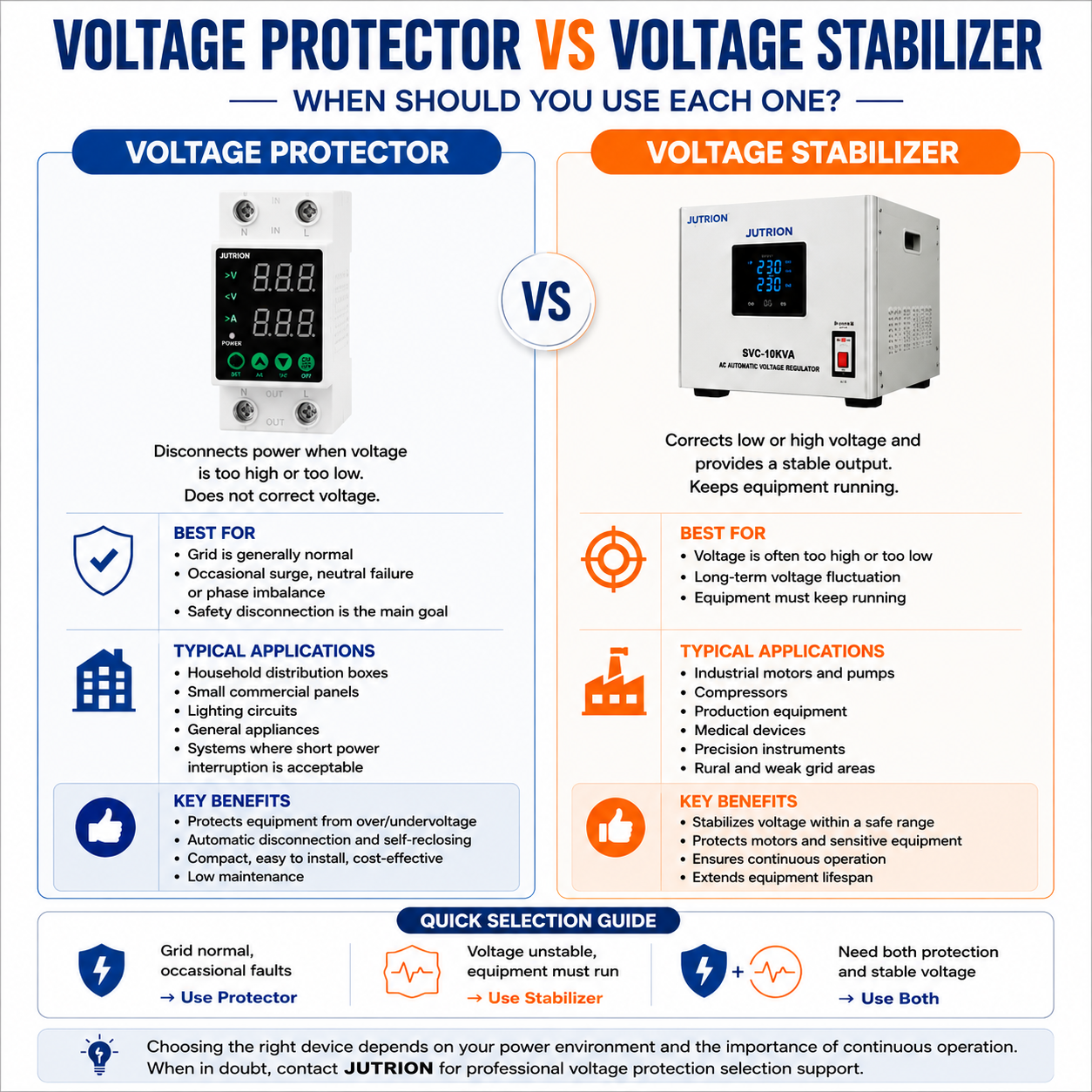
Voltage Stabilizer vs. Over and Under Voltage Protector: What Is the Difference?
2026-05-14 14:37:10