



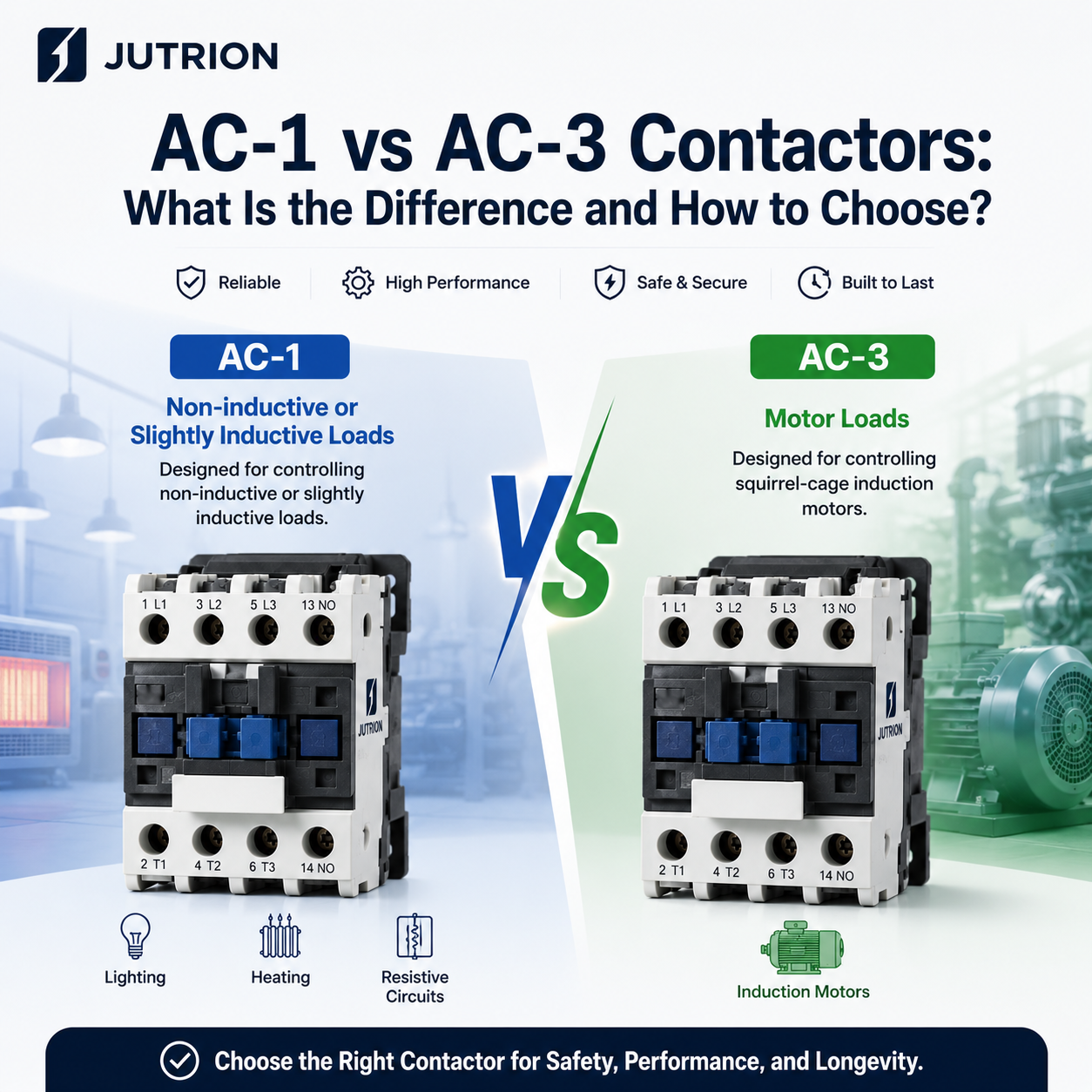
AC-1 vs AC-3 Contactors: What Is the Difference and How to Choose?
When selecting an AC contactor, many users first look at the rated current on the product label, such as 25A, 40A, or 63A. However, in real electrical projects, current rating alone is not enough, because the same contactor may have different carrying and breaking capacities under different load conditions.
Quick Comparison: AC-1 vs AC-3 Contactors
AC-1: Used to control purely resistive loads, such as electric heaters, ovens, and lighting loads. It is economical and durable.
AC-3: Used to control three-phase asynchronous motors, such as fans, pumps, and compressors. The contactor must be selected according to the motor power and AC-3 rating.
Quick Comparison Table
Item | AC-1 | AC-3 |
Load Type | Resistive loads | Motor loads |
Making Current | Close to rated current | About 6× rated current |
Breaking Current | Rated current | Rated running current |
| Contact Stress | Lower | Higher |
| Selection Rule | Heating / resistive loads | Motor starting / stopping |
Do not mix them: Using an AC-1 contactor for motor control can easily cause contact burning. Using an AC-3 contactor for resistive loads may increase cost unnecessarily.
What Do AC-1 and AC-3 Mean on a Contactor?
We have already gained a basic understanding of AC-1 and AC-3 contactors. Next, let’s take a closer look at what these two utilization categories mean.
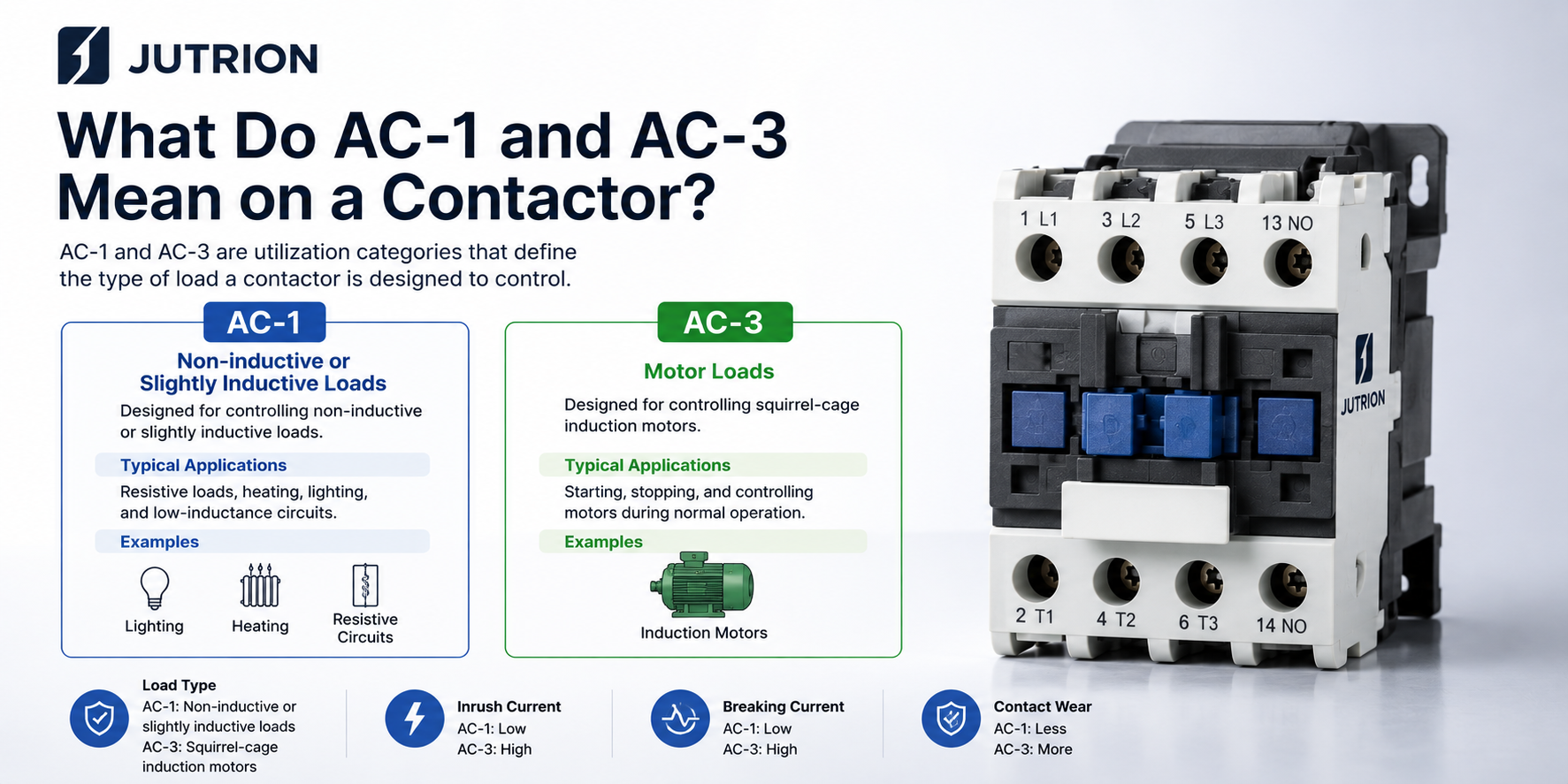
JUTRION AC-1 vs AC-3 contactor load category comparison
AC-1 Standard Parameters
Item | AC-1 Parameter |
Load Type | AC non-inductive or slightly inductive loads |
Power Factor | cosφ ≥ 0.95 |
Test Making Current | Im = 1Ie |
Test Breaking Current | Ib = 1Ie |
Making Voltage | 1.1Ue |
Breaking Voltage | Ue |
Current Impact | Low inrush current, stable current |
Contact Stress | Low arc energy and low contact wear |
Typical Applications | Heating equipment, resistive loads, resistive lighting circuits |
AC-3 Standard Parameters
Item | AC-3 Parameter |
Load Type | Three-phase squirrel-cage induction motors |
Power Factor | cosφ = 0.35–0.65 |
Test Making Current | Im = 6Ie |
Test Breaking Current | Ib = 1Ie |
Making Voltage | 1.1Ue |
Breaking Voltage | Ue |
Current Impact | High starting current during motor startup |
Contact Stress | Higher arc energy and higher contact wear |
Typical Applications | Motor starting and stopping, fans, pumps, compressors |
These test parameters explain why the same contactor can have a higher AC-1 rating but a lower AC-3 rating.
The Core Difference: Resistive Loads vs. Motor Loads
Difference in Making and Breaking Capacity
AC-1: Making and breaking are both at rated current, with no overload impact.
AC-3: Makes 6 times the rated current, but only breaks the rated running current.- Difference in Current Rating
For contactors of the same specification:AC-1 rated current > AC-3 rated current - Difference in Withstand Capability
AC-1: Not designed to withstand starting current impact.
AC-3: Specially designed to withstand motor starting current impact. - Difference in Application Boundary
AC-1: Only suitable for resistive loads and should not be used to drive motors.
AC-3: Only suitable for regular motor starting and stopping. It is not suitable for frequent jogging, inching, or reversing operations.
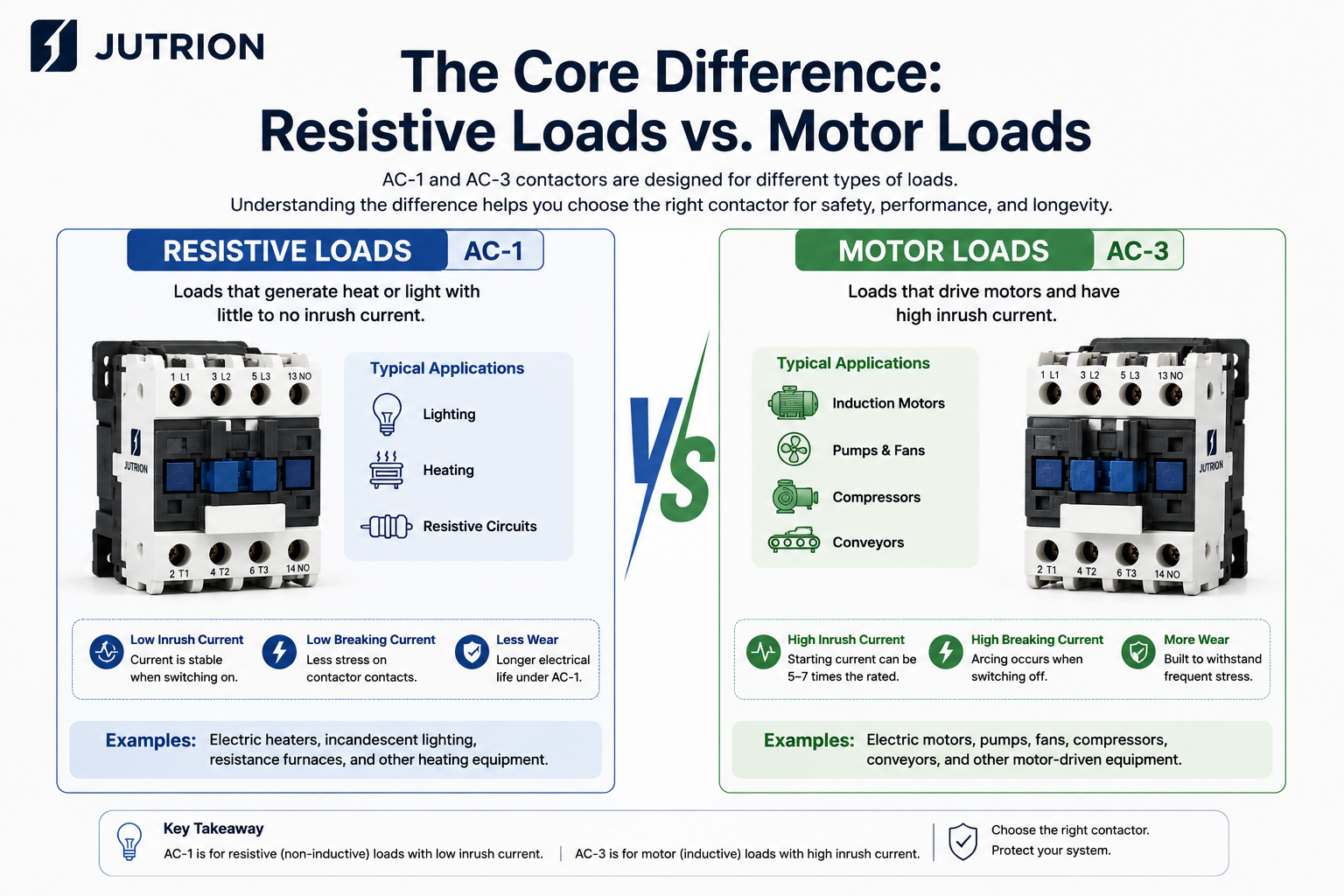
Why AC-3 Ratings Are Usually Lower Than AC-1 Ratings
Motor starting current is much higher
AC-3 contactors are used for motor loads. During motor startup, the contactor must close under a high inrush current, which is usually about 5–7 times the motor rated current. In standard AC-3 test conditions, the making current is typically expressed as:Im = 6Ie
For AC-1 resistive loads, the current is much more stable:Im = 1Ie- Motor loads have a lower power factor
AC-1 loads are mainly resistive or slightly inductive loads, with a high power factor:cosφ ≥ 0.95
AC-3 loads are motor loads. During motor operation, the power factor is much lower, commonly around:cosφ = 0.35–0.65
A lower power factor means the load is more inductive. When the circuit is opened, the arc is harder to extinguish, so the contacts face higher electrical stress. - AC-3 creates stronger arc energy
For AC-1 loads, both making and breaking are close to the rated current:
Im = 1Ie
Ib = 1Ie
For AC-3 loads, the contactor must make a much higher current during startup:
Im = 6Ie
Ib = 1Ie
Although AC-3 normally breaks the motor running current, the contactor still suffers from repeated starting impact and stronger arc erosion. This reduces the allowable rated current under AC-3 conditions. - AC-3 requires more safety margin
Under AC-3 conditions, the contactor must withstand motor starting current, inductive load stress, arc erosion, and repeated electrical wear. To maintain electrical life and reliability, the same contactor must be rated lower under AC-3 than under AC-1.
In simple terms:
AC-1 = stable resistive current, lower contact stress
AC-3 = motor starting current, higher contact stress
That is why the same contactor may be marked, for example, with a higher AC-1 current but a lower AC-3 motor rating.
How to Choose the Right Contactor for AC-1 Loads
Confirm the load type
AC-1 contactors are mainly used for non-inductive or slightly inductive loads, such as electric heaters, resistance furnaces, ovens, and resistive lighting circuits. Before selection, make sure the load does not have high starting current like a motor.Select according to the AC-1 rated current
The AC-1 rated operational current Ie of the contactor should be equal to or higher than the continuous load current. For example, if the heater current is 32A, the selected contactor should have an AC-1 rating higher than 32A.- Check the main circuit voltage and coil voltage
Check whether the contactor’s rated operational voltage Ue matches the system voltage, such as 230V, 400V, or 690V. Also confirm the coil voltage, such as AC 220V, AC 230V, AC 380V, or DC 24V. - Leave a margin for harsh environments
If the ambient temperature is high, the cabinet ventilation is poor, or the switching frequency is high, leave a proper current margin or select a larger contactor according to the manufacturer’s datasheet.
How to Choose the Right Contactor for AC-3 Motor Loads
- Rated Current Matching
Use the motor full-load current FLA as the basic selection value. The contactor must be selected according to the AC-3 rated operational current Ie marked on the contactor nameplate.
Key reminder: For the same contactor, the AC-3 rated current is always lower than the AC-1 rated current. Do not mix them. - Starting Current Withstand Capability
An AC-3 contactor must be able to withstand the motor starting current, which is usually about 6 times the rated current (6×Ie).
It must also meet the standard operating condition of breaking 1 times the rated current (1×Ie) during normal running. - Power Factor Consideration
Motor loads usually have a lower power factor, around cosφ = 0.35–0.65.
Because motor loads are inductive, the contactor will face higher arc energy and greater contact stress than resistive loads. - Environmental and Operating Condition Correction
Ambient temperature: If the ambient temperature is above 40°C, derating or a larger contactor size may be required.
Altitude: If the altitude is above 1000 m, air density becomes lower and arc-extinguishing performance may decrease, so derating may be required.
Operating frequency: Standard AC-3 contactors are suitable for regular motor starting and stopping. For frequent jogging, inching, or reversing operations, AC-4 should be considered.
Common Mistakes When Selecting AC-1 and AC-3 Contactors
Using an AC-1 contactor for motor loads
An AC-1 contactor is not designed to withstand the high starting current of a motor, which can usually reach about 6 times the rated current. Using it for motor loads may cause serious contact burning, contact welding, or direct equipment failure.- Selecting a motor contactor based on the AC-1 rated current
Some users choose a contactor according to the higher AC-1 current rating and ignore the AC-3 rating. This is a common mistake. For motor applications, the contactor must be selected according to the AC-3 rated operational current Ie, not the AC-1 current rating. - Ignoring environmental derating
High ambient temperature, high altitude, poor cabinet ventilation, and limited heat dissipation can reduce the contactor’s actual carrying capacity. If these conditions are ignored, the contactor may run hot for a long time and accelerate insulation aging. - Using AC-3 for frequent jogging, inching, or reversing
A standard AC-3 contactor is mainly used for normal motor starting and stopping. It is not suitable for frequent jogging, inching, plugging, or reversing operations. For these harsher operating conditions, AC-4 should be considered. - Choosing the wrong coil voltage
If the coil voltage does not match the control circuit voltage, the contactor may fail to pull in, pull in unstably, vibrate frequently, or burn out the coil directly. Always confirm the control coil voltage before selection, such as AC 220V, AC 230V, AC 380V, DC 24V, or DC 110V.
7-Point Contactor Selection Checklist
Utilization Category:Confirm that the load type matches the correct utilization category. Use AC-1 for resistive loads and AC-3 for regular motor loads.
- Rated Operational Current (Ie):Select the contactor strictly according to the rated current of the corresponding utilization category, and leave a proper safety margin.
- Rated Operational Voltage (Ue):Make sure the main circuit rated operational voltage matches the system supply voltage.
- Coil Voltage:Confirm that the control coil voltage matches the control circuit power supply.
- Environmental Conditions:Apply derating factors or choose a higher-protection model according to temperature, altitude, dust, and corrosion conditions.
- Operating Frequency:Check the mechanical and electrical life of the contactor to ensure it meets the required start-stop frequency on site.
- Auxiliary Contacts:Confirm the number and type of auxiliary contacts, such as NO and NC, to meet the control and interlocking requirements.
For more detailed technical requirements and utilization category definitions, please refer to the IEC 60947-4-1 standard.
If you need to select the right AC contactor for your project, feel free to contact our engineering team for professional technical support and product selection advice.
FAQs:
Why is the AC-3 rated current always lower than the AC-1 rating on the same contactor?
- During motor startup under AC-3 conditions, the contactor must close under a high inrush current, usually about 5–7 times the motor rated current.
Additionally, motor loads have a lower power factor (commonly around cosφ = 0.35–0.65), meaning the load is more inductive.
This creates stronger arc energy and higher electrical stress when the circuit is opened.
To maintain electrical life and reliability under these harsh conditions, the same contactor must be rated lower under AC-3 than under AC-1
- Is a standard AC-3 contactor suitable for frequent jogging or reversing operations?
No, a standard AC-3 contactor is only suitable for regular motor starting and stopping.
It is not suitable for frequent jogging, inching, plugging, or reversing operations.
For these harsher operating conditions, an AC-4 contactor should be considered.
Choosing between an AC-1 and AC-3 contactor comes down to understanding your specific load. Remember the golden rule: never use an AC-1 contactor for motor starting, as it will inevitably lead to contact burning and system failure. Conversely, oversizing an AC-3 contactor for a simple resistive load only adds unnecessary costs to your project. By following the 7-point selection checklist, you can ensure your equipment runs safely, reliably, and cost-effectively.
-
Air Circuit Breakers (ACB) Explained: Structure, Protection, and Main Distribution Applications
2026-05-24 22:21:27 -
AC-1 vs AC-3 Contactors: What Is the Difference and How to Choose?
2026-05-20 19:31:24 -
Surge Protector vs. Voltage Protector: What’s the Difference? (Complete Guide)
2026-05-18 17:50:53 -

Selection and Installation Guide for SPDs in Solar PV Systems
2026-05-16 12:54:43 -
Voltage Stabilizer vs. Over and Under Voltage Protector: What Is the Difference?
2026-05-14 14:37:10