


RCBO vs GFCI Breaker: IEC vs NEC Guide for US Engineers
RCBO vs GFCI Breaker: IEC vs NEC Guide for US Engineers
Last winter, Houston-based Sarah Kowalski's team received a panel schedule from a German EPC contractor that listed "1P+N RCBO 16A 30mA Type A IEC 61009." She'd been spec'ing NEC equipment for 11 years. She'd never written those characters on a drawing.
It's not a knowledge gap, but a jurisdiction clash that unfolds over and over on r/electricians and r/electrical. IEC 61009 regulates circuit protection throughout the EU, UK, Australia, Middle East and most of Asia. So when a US engineer joins cross-border EPC, or when EU equipment shows up at a US jobsite with an IEC panel schedule clamped to it, IEC and NEC breaker standards suddenly have to talk to each other.
The collision points are predictable. Middle Eastern oil and gas projects like IEC because the lead EPC is European. US companies that build data centers for European customers spec IEC-standard UPS and distribution equipment. Solar farms that use European inverters will ship with IEC-based protection requirements built into the equipment documentation. The sharpest knife edge is offshore and marine: IEC 60092 regulates electrical installations on ships with any flag. So a US-flagged vessel that has a ABS or DNV class surveyor peeling its back in US waters still needs to have IEC 60092 compliant switchgear on board. The NEC doesn't apply.
The outcome is that a US engineer who has never dealt with DIN rail equipment suddenly has decoders written in IEC shorthand. An RCBO on the panel schedule that says "Type A, 10mA, 1P+N, B10" will tell you the type of residual current, trip sensitivity, pole configuration and magnetic characteristic. All of those are clobbered with the way UL 489 or UL 943 describe a GFCI breaker. How those characters work and why someone chose those particular characters is where you need to start before you go making any substitution decision.
Why American Engineers Run Into RCBO
Last Winter, Sarah Kowalski's team in Houston were sent a panel schedule from a German EPC contractor that said "1P+N RCBO 16A 30mA Type A IEC 61009". She had been specifying NEC equipment for 11 years. She had never written those characters on a drawing.
That scenario is a staple on r/electricians and r/electrical. There's no knowledge gap. There's a jurisdiction collision. IEC 61009 is the circuit protection standard for the EU, UK, Australia, Middle East, and most of Asia. When an American engineer gets involved in a cross-border EPC, or when a European piece of equipment is shipped to a US jobsite with an IEC panel schedule, the IEC NEC breaker standards suddenly need to talk to each other.
The collision points are fairly predictable. Oil and gas projects in the Middle East tend to follow IEC because the EPC is European. Data centers built by an American company for a European operator will specify IEC standard UPS and distribution equipment. Solar farms using European inverters ship with IEC based protection requirements in the equipment documentation. The sharpest edge case is offshore and marine. IEC 60092 is the electrical installation standard for ships regardless of vessel flag. To operate a US-flagged vessel in US waters under an ABS or DNV class survey, you'd still need IEC 60092 compliant switchgear. You don't need to follow the NEC.
The result is a misshapen engineer on the other end of the pantheon who has never shopped with a DIN-rail vendor and is suddenly reading specs in IEC shorthand. An RCBO spec'd to "Type A, 10mA, 1P+N, B10" tells you the residual current type, trip sensitivity, pole configuration and magnetic characteristic. None of that translates to how UL 489 or UL 943 would describe a GFCI breaker so you have to understand what those characters mean, and why they were selected, before you can even make a substitution.
What Is an RCBO?
So you can act like that MCB upstream is not there. One device, one DIN rail slot, both protection. And that's why it's so widely used in European residential and light commercial distribution boards: small, no coordination required between two devices. Have a look at JUTRION's full RCBO products range for IEC 61009-1 compliant devices.
Mechanical specs are available from useful range. Current ratings are 6A to 63A for residential and light commercial, industrial models are available above this. Ground fault trip sensitivity over 10mA (medical, high sensitivity equipment) 30mA (standard for personal protection) 100mA (fire protection) and 300mA (equipment protection, no personnel). 1P+N is the most common pole configuration for residential, but 2P, 3P and 4P three-phase is also offered. Physical width 18mm for a 1P+N up to 36mm for a 4P.
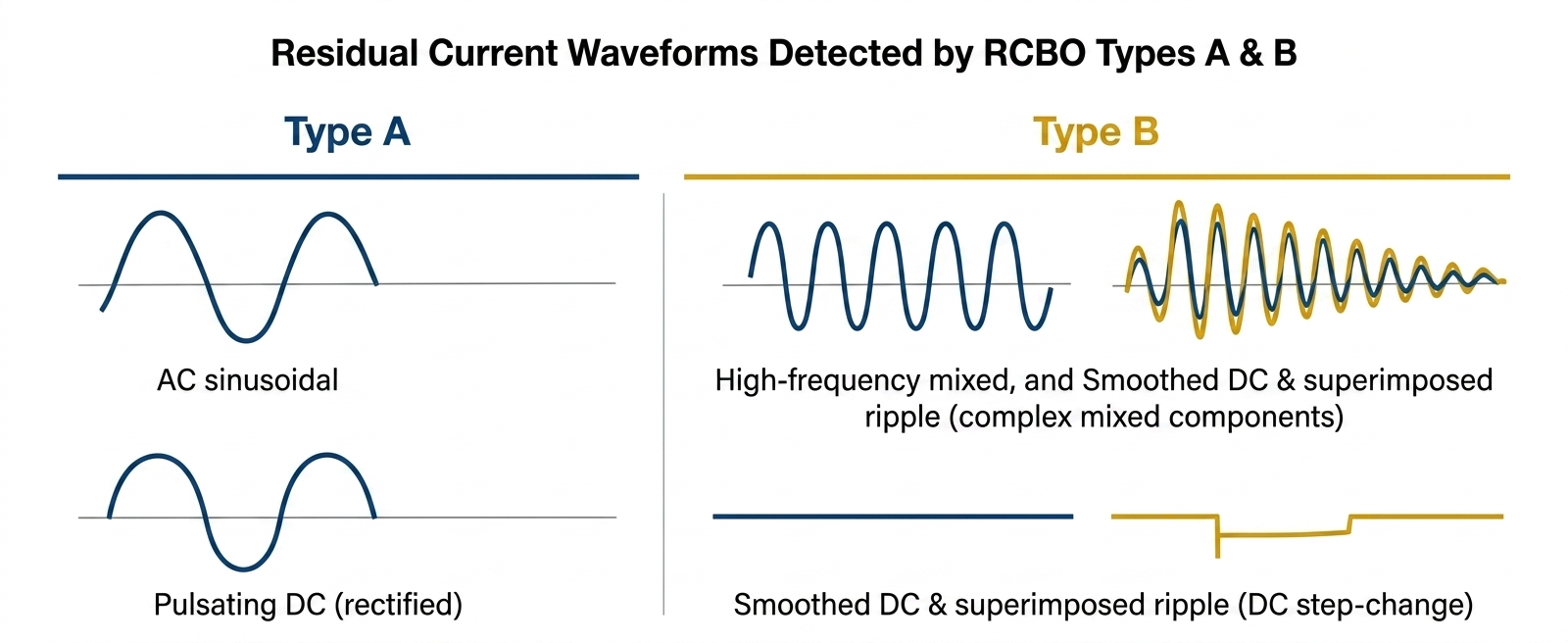
The Type variants are more about waveform than sensitivity. Type AC devices only trigger on sinusoidal AC residual current. Type A adds pulsating DC residual currents on top, which will be what you get from most appliances with a rectifier stage. Type F adds high frequency residual currents from variable speed drives. Type B adds smooth DC residual currents, required for three phase inverter equipment including solar PV systems and EV chargers. Specifying a Type AC on a circuit feeding a VFD is non-compliant with IEC 61009 -- and it won't trip on the fault type that drive actually generates.
Definition
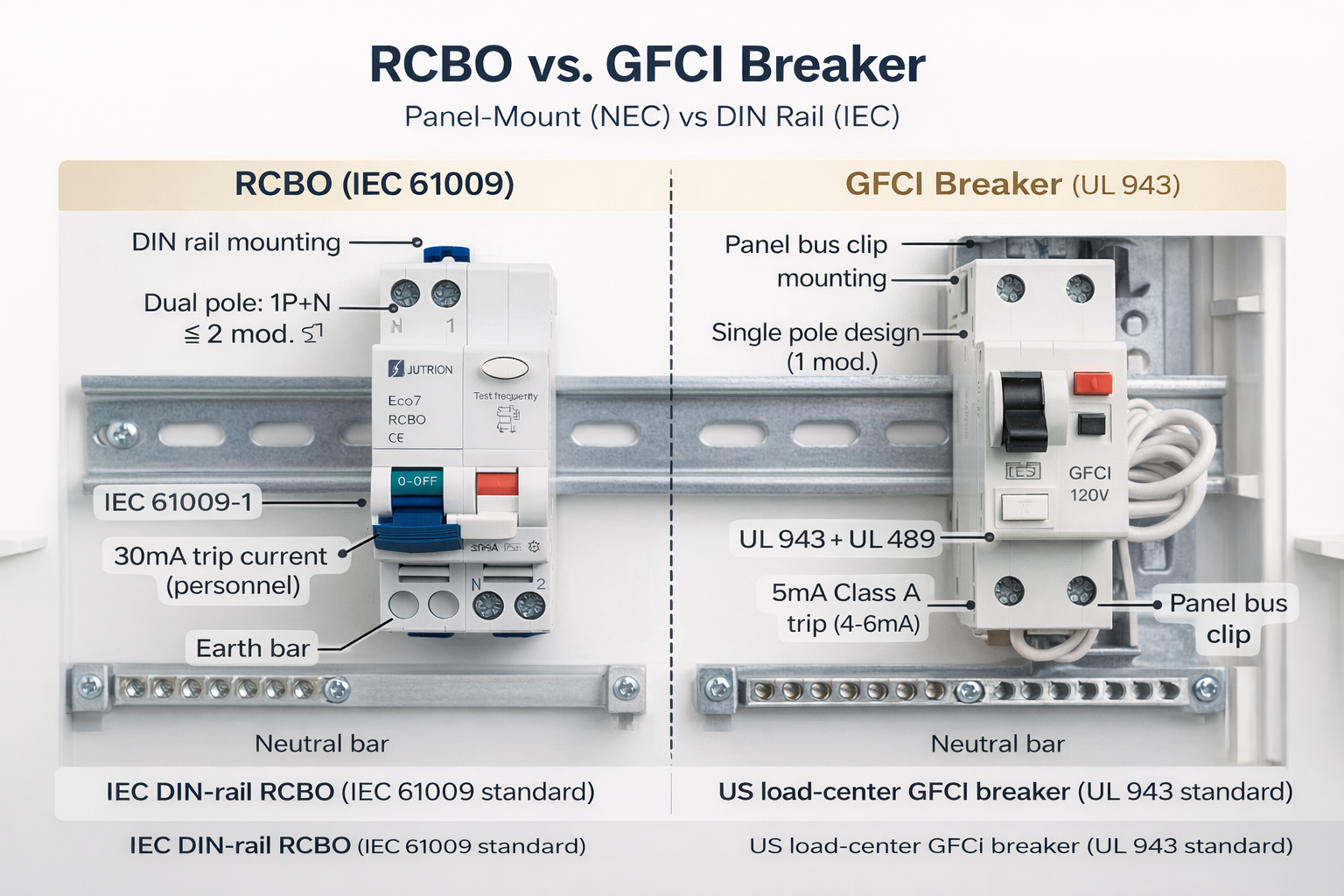
An RCBO is a Residual Current Breaker with Overcurrent protection. It is a single DIN-rail device which combines the operating principle of an RCCB (residual current circuit breaker, ground fault detection) with that of an MCB (miniature circuit breaker, overcurrent and short circuit protection). The standard in complaint is theIEC 61009-1, the European harmonised version EN 61009-1 (CE Marking).
What Is a GFCI Breaker
A GFCI breaker is a breaker style GFCI -- a panel-mounted device that will trip when it senses a ground fault current that exceeds its trip threshold, while simultaneously providing UL 489 rated overcurrent protection. The two standards relevant here are UL 943 (ground fault protection) and UL 489 (overcurrent interrupting capacity). It's a UL Listed device, not CE marked, and installs into a US residential or commercial load center using the panel's bus clip system.
NEC 210.8 gives location requirements for GFCI protection of receptacles and equipment in residential construction. NEC 210.8(A) requires GFCI protection in (1) bathrooms, (2) garages, (3) outdoors, (4) crawl spaces, (5) unfinished basements, (6) kitchen countertop receptacles within 6 ft of sink, (7) boathouses, (8) accessory buildings with grade-level access. The 2020 NEC expanded many of these locations dramatically.
Class A trip at no more than 6 mA (but operates within a range of 4-6 mA), which is the only classification permitted for personnel protection in the US. Class B trips at 20mA and only applies to underwater lighting applications. There is no US equivalent for IEC's 30mA designation for personnel protection.
Physical installation is essentially a different ball game than an RCBO. GFCI breaker can be mounted to the panel bus with a plug-on or bolt-on clip -- the same clip type used for a standard circuit breaker. No DIN rail. Device width is 1 to 1.5 inches per pole, expressed in inches, not millimeters. Major load centre families (Square D QO, Eaton BR, Siemens HOM) are not compatible -- a QO GFCI breaker will not clip into an Eaton BR panel. Panel-family compatibility is a very hard constraint for procurement, with not even the slightest equivalent in the DIN-rail world, where a compliant 35mm RCBO will fit a fully compliant 35mm distribution board.
RCBO vs GFCI Breaker: Side-by-Side Comparison
Everyone knows that an RCBO and a GFCI breaker offer together both ground fault and overcurrent protection in a single device. And everyone also knows that this functional similarity is exactly what provokes procurement errors. Everyone can see "combined protection, one device" and from that conclusion they automatically assume they are synonymous.
| Feature | RCBO (IEC) | GFCI Breaker (NEC) | Dual Function Breaker (NEC) |
|---|---|---|---|
| Governing standard | IEC 61009-1 / EN 61009-1 | UL 943 + UL 489 | UL 943 + UL 489 + UL 1699 |
| Region of use | EU / UK / AU / Asia / Middle East | US / Canada | US / Canada |
| Typical trip current (GF) | 30 mA (personal) / 10 mA (medical) | max 6 mA Class A (typ. 4-6 mA) | max 6 mA Class A (typ. 4-6 mA) |
| Arc fault protection | No (separate AFDD per IEC 62606) | No (standard GFCI only) | Yes (AFCI + GFCI combined) |
| Overcurrent protection | Yes (MCB function built in) | Yes (UL 489 breaker) | Yes (UL 489 breaker) |
| Voltage range | 230 / 400 V AC (50 Hz) | 120 / 240 V AC (60 Hz) | 120 / 240 V AC (60 Hz) |
| Physical mounting | 35 mm DIN rail | Panel bus clip (plug-on / bolt-on) | Panel bus clip (plug-on / bolt-on) |
| Typical width | 18-36 mm per pole | 1-1.5 in per pole | 1-1.5 in per pole |
| Certification marks | CE / CB Scheme / TUV | UL Listed + NEMA | UL Listed + NEMA |
| Trip type variants | Type AC / A / B / F | Class A only | Class A + CAF |
| Test endurance | 10,000-20,000 operations (IEC 61009-1 Cl. 9) | UL 943 endurance | UL 943 + UL 1699 endurance |
| Typical price (2026, approx.) | $15-$60 per pole | $30-$80 per pole | $40-$120 per pole |
| NEC 2020 residential mandate | Not applicable (IEC territory) | Required locations per 210.8 | Required where AFCI + GFCI both needed |
Physical mounting alone is not a solution. 30mA RCBO on a US job does not comply with NEC 210.8 if AHJ takes the idea at face value -- there is no panel bus clip and there is no UL listing. Specs right the first time: the right device for the right jurisdiction. Any job shipping to both US and EU markets? Spec them both! One DIN-rail distribution board for the IEC circuits; one UL listed load center for the NEC circuits. You will pay more for trying to retrofit one with the other at install time than for building it correctly at design time.
The Trip Current That Actually Matters
The most common question engineers get asked is whether a 30mA RCBO provides acceptable personnel protection when you compare it to a 6mA GFCI breaker. We certainly agree with the question but the answer is probably not what people think. IEC did not pick 30mA because European standard setting bodies were less concerned about electrocution than US ones. They chose 30mA based on the IEC 60479-1 Human Body Current Model and the zones of physiological response that current creates. The 30mA is not random. It is, in fact, the cut-off between Zone AC-4.1 where the probability of ventricular fibrillation going bad is below 5% and Zone AC-4.2 where the probability is higher (5-50%). The US standard decided to be more conservative by choosing a maximum of 6 mA. That is in Zone AC-3 where the only effect is reversible muscle contraction and no significant cardiac risk. These are defensible choices because they are based on the same science, but they will behave very differently in practical fields.
Key Statistic
30 / 5 = 6x -- UL 943 Class A trips at 5 mA (nominal). That's 6x the threshold of the IEC personal protection standard. In other words, a GFCI breaker will trip when the test current trips an IEC RCBO.
IEC 60479-1:2018 defines AC current effect zones (15-100 Hz): AC-1 <0.5mA (not perceived); AC-2 0.5-2mA (perceived but not harmful); AC-3 2-10mA (reversible muscle contraction); AC-4.1 >10-50mA (probability of ventricular fibrillation below 5%); AC-4.2 50-250mA (probability between 5-50%); AC-4.3 >250mA (probability above 50%). So IEC 30mA is right on the AC-4.1 boundary. It is protective but doesn't have to go over to the making-fibrillation zone.
IEC 60364-4-41 calls this out explicitly: It allows 30mA as a general protection threshold but back it out by requiring a 10mA rating for Group 2 circuits in a medical location (IEC 60364-7-710). They sincerely do not think that 30mA is a band-aid. They think it is the right value for general non-medical use.
And this mechanism is calibrated to the science. We know, because IEC would have had to realize that if you only let it be 5mA there would be a lot of nuisance tripping on normal circuits with normal capacitive and resistive leakage currents. On long runs of cable in wet places, on HVAC compressors, variable frequency drives.
Pro Tip
On VFD-enriched industrial sites 30mA RCBO may nuisance trip. The cure is not to eliminate ground fault protection, but to use Type B RCBO (smooth DC residual detection) and make sure cable screen grounding & EMC filter design does not produce actual normal-mode leakage >15mA. Always check with the VFD's installation manual -- Siemens, ABB and Danfoss all publish the leakage current per drive model & cable length.
Don't put a Type AC RCBO on a circuit feeding any equipment which has a switching power supply, rectifier, or VFD. Type AC can only sense sinusoidal residual current. A fault current caused by a failed rectifier stage will have pulsating DC components that the Type AC device will just miss. You end up with a device that looks like it is protecting the circuit but is not tripping on the fault type which is most likely to happen. IEC 60364-4-41 requires A for most modern appliances, B for three-phase inverter loads.
When Do US Engineers Actually Need an RCBO?
Key Answer
The IEC vs NEC Project Classification Framework starts with one question: what standard governs the electrical installation on this project? That answer isn't always the NEC, even for US engineers working for US firms. Five project types regularly pull US engineers into IEC territory, and getting the classification wrong at the start of a project costs significantly more than getting it right. Reclassifying mid-design means redrawing single-line diagrams, respecifying protection devices, resubmitting drawings for approval, and absorbing the procurement premium of switching suppliers on a compressed schedule. That's typically a four-to-eight-week setback with cost exposure in the tens of thousands before you've touched a single panel. An RCBO specified on a NEC-governed domestic installation won't pass inspection. A UL-listed GFCI breaker specified on an IEC-governed offshore installation won't pass class survey. The classification decision isn't a preferences discussion -- it's a standards jurisdiction determination that should happen at project initiation, before any single-line diagram is drawn.
Tom Hendricks, senior electrical engineer at an EPC firm in Houston, had been assigned to the electrical package for a floating production storage and offloading vessel for a West African operator. The vessel would be ABS-classed, it would be operated by a European oil major, and its hull was under construction in South Korea. Tom's team began drafting the panel schedules using NEC conventions, simply because that was what they knew. The ABS plan approval review at its core rejected the protection device specifications. Per IEC 60092-302, the residual current devices must be compliant with either IEC 61008 or IEC 61009: UL 943 listing alone doesn't meet it. Re-writing the panel schedules and re-sourcing the IEC compliant RCBOs from European suppliers added six weeks to the procurement schedule and approximately $40,000 to engineering rework. The cause: the IEC vs NEC project classification was not made clear at kickoff.
Five big project categories actually require a US engineer to work with RCBOs:
First, international EPC contracts with a European lead contractor. Typically in the Middle East oil and gas. If it's a European EPC leading the job, electrical is IEC by default. US subcontractors on those packages need to spec IEC products. It's not negotiable through a procurement process -- it's written in the contract technical schedule.
Second, marine and offshore under IEC 60092. IEC 60092 governs ships and offshore structures classed under IACS member societies (ABS, DNV, Lloyd's, Bureau Veritas). It doesn't matter whether the vessel is US-flagged, financed by a US company, or operating in US territorial waters. Class rules and class demands IEC.
Third, data centers with European UPS equipment. Schneider Galaxy, Eaton 93PM, and ABB PowerValue UPS platforms are built around IEC internal architecture and use DIN-rail RCBOs for sub-circuit distribution. If you're installing that equipment into a US data center, you will need IEC protection on the circuits in the UPS distribution section even if the upstream distribution is NEC.
Fourth, solar PV with European inverters. SMA, Fronius, or Huawei solar inverters sold into the US market specify Type B RCBO on the AC side in their installation manuals because Type B can detect smooth DC residual current, which three-phase string inverters can produce under certain fault conditions. There's no Type B UL 943 equivalent.
Fifth, US OEM equipment exported to EU, UK, or Australia. If you're a US OEM making control panels or machines in the United States for export, CE marking under the Low Voltage Directive requires IEC-compliant protection devices within the panel. You will spec RCBOs in the export version of the equipment even if you spec GFCI breakers in the domestic version.
NEC 90.4 does allow AHJ to accept equivalents. But don't treat "AHJ acceptance" as a procurement strategy. It requires pre-approved documentation, it's jurisdictional, and not every AHJ will agree. If your project governance requires IEC, document that at design basis. Ambiguity in project classification is where the rework cost is hidden. Find the IAEI guide on UL 943 standards for further reading on type selection.
Pro Tip
On projects that genuinely span both IEC and NEC jurisdictions -- a US-manufactured machine being installed in both domestic and EU facilities -- the cleanest solution is to maintain two panel configurations in your BOM. One UL-listed GFCI breaker version for US installations, one IEC 61009 RCBO version for EU/UK. The cost of maintaining two configurations is lower than the cost of managing non-conformance reports in both markets.
The Dual Function AFCI/GFCI Breaker: The US-Only Evolution
The dual function circuit breaker is a unique product category that has no IEC equivalent. NEC 2020 Section 210.12 requires AFCI protection of virtually all 120V branch circuits that feed outlets in dwelling unit habitable areas -- bedrooms, kitchens, family rooms, dining rooms, living rooms, and more. The result was a device specification problem: contractors needed both arc fault and ground fault protection in one breaker slot. The US solution combined UL 1699 AFCI detection with Class A GFCI sensing in a single module. No IEC equivalent in a single device. Under IEC standards, you'd specify an RCBO per IEC 61009 for residual current protection and a separate AFDD per IEC 62606 for arc fault detection. Two devices, two DIN rail slots, two test certificates.
| Feature | RCBO (IEC) | Dual Function Breaker (NEC) |
|---|---|---|
| Arc fault detection | No (AFDD is a separate IEC device per IEC 62606) | Yes (AFCI per UL 1699) |
| Ground fault threshold | 30 mA (personal) / 10 mA (medical) | max 6 mA Class A |
| Voltage system | 230/400 V 50 Hz | 120/240 V 60 Hz |
| Required by code | IEC territory projects | NEC 2020 Section 210.12: dwelling unit habitable areas |
| IEC equivalent | RCBO + separate AFDD | No direct IEC equivalent in one module |
| US search trend (2026) | Stable (IEC-project driven) | +122% year-over-year (NEC 2020 mandate effect) |
Key Statistic
The dual function circuit breaker grew +122% year-over-year in search volume (DataForSEO Labs, US, April 2026), driven by the NEC 2020 mandate requiring AFCI+GFCI protection in new residential construction.
When you see a dual function circuit breaker on a US residential project, it's responding to a code requirement with no IEC counterpart. If you're working from an IEC drawing and need to respecify for a US site, you'll need to reconfigure both the residual current and arc fault devices separately, or source a US-listed dual function unit. These product families are not interchangeable.
IEC to NEC Translation Cheat Sheet
Bookmark this section. When you've got a European drawing in front of you and a US inspector asking questions, this table is the fastest way to get to the right device designation and the right standard. IEC and NEC use different naming conventions for what are functionally similar devices, but the differences in trip thresholds, certification bodies, and installation rules matter for IEC NEC breaker standards compliance. The naming confusion is the easy part -- the threshold and listing differences are where projects get held up.
| IEC Term | IEC Standard | NEC Equivalent | NEC/UL Standard | Key Difference |
|---|---|---|---|---|
| RCCB | IEC 61008 | GFCI receptacle | UL 943 | RCCB 30mA; GFCI receptacle max 6mA |
| RCBO | IEC 61009 | GFCI breaker | UL 943 + UL 489 | 30mA IEC vs max 6mA US; CE not equal to UL Listed |
| RCBO + AFDD | IEC 61009 + IEC 62606 | Dual function AFCI/GFCI breaker | UL 943 + UL 489 + UL 1699 | IEC uses two devices; NEC uses one |
| MCB | IEC 60898 | Miniature circuit breaker | UL 489 | IEC Curve B/C/D vs NEC HACR/SWD |
| MCCB | IEC 60947-2 | Molded case circuit breaker | UL 489 | DIN rail vs panel-mount frame |
| AFDD | IEC 62606 | AFCI breaker | UL 1699 | Arc fault detection; separate device in IEC |
| Isolator / switch-disconnector | IEC 60947-3 | Disconnect switch | UL 98 | Visible blade not required in all NEC jurisdictions |
| Contactor | IEC 60947-4-1 | Magnetic contactor | UL 508 | IEC AC-1/AC-3 duty cycle vs NEC horsepower rating |
| Busbar (TN-S) | IEC 60364 | Panelboard (split phase) | NEMA PB1 | IEC TN-S earthing vs NEC grounded neutral |
Key Takeaway
The table maps device names across nine entries, but don't stop there. Every row has a threshold or certification difference that changes what you can install and where. Use the IEC term to find your row, then verify the NEC/UL standard column before you write the specification.
Certification Gotchas for Cross-Border Projects
CE marking is not third-party certification. It's a self-declaration by the manufacturer stating the product meets EU directives. No independent testing lab needs to sign off. When a US Authority Having Jurisdiction sees a CE mark on a breaker, it tells them nothing about UL 489 or UL 943 compliance. NEC 90.4 gives the AHJ authority to reject any equipment it determines is unsafe, regardless of any equivalency arguments made on site.
Warning
CE-only equipment installed in a US project creates two distinct risks: AHJ rejection at inspection, and potential void of property insurance coverage. US insurers typically require equipment certified by a Nationally Recognized Testing Laboratory (NRTL). CE marking doesn't satisfy that requirement.
Here is an AHJ rejection in practice. A general contractor in Houston -- Meridian Industrial Group -- installed CE-marked IEC breakers in a skid package being installed in a refinery expansion. The skid was fabricated offshore, shipped to a US facility, and inspected locally. The AHJ flagged every IEC breaker on the panel. None were UL Listed. The contractor had to pull the panel, source UL 489-listed replacements, retest the skid, and reschedule commissioning. The documented rework cost exceeded $100,000 -- re-termination labour, replacement panels, third-party re-inspection, and shipping delays. The IEC breakers were perfectly functional. They just weren't listed.
The CB Scheme (IECEE) is the right path out of this situation. A CB Scheme test report, issued by a National Certification Body, can help national marks bodies such as UL reduce the retesting required when granting a UL Listing -- although the UL review and any US-specific supplemental tests still apply. If you're specifying IEC equipment for a project with potential US-side inspection exposure, require a CB Scheme test report from the manufacturer before you write the spec.
A small number of US projects run IEC equipment with documented NEC 90.4 equivalency justification. That requires written engineering justification, a professional engineer's stamp, and AHJ sign-off in writing before the equipment is ordered. It's not a retroactive fix. If this is your path, start the conversation with the AHJ during design, not commissioning.
How to Buy IEC RCBOs as a US Engineering Company
For US engineers procuring IEC RCBOs for export projects or international facility design, the CB Scheme test report is the single most important document to request from any supplier. It's issued under the IECEE mutual recognition arrangement and accepted by National Certification Bodies in more than 50 countries. A CB report means your IEC RCBO type test data has been independently evaluated. If your project scope shifts and US AHJ inspection becomes a requirement, that CB report is your starting point toward a UL mark with minimal retesting burden. Not requesting one at the RFQ stage means you're facing an eight to fourteen week full independent test campaign costing $15,000 to $40,000 depending on device ratings -- a time and budget requirement that most project schedules don't accommodate. Require the CB Scheme test report at the RFQ stage, confirm it covers the specific model and ratings you're procuring, and verify it's still current before the purchase order is placed.
US engineering firms sourcing IEC RCBOs for export projects don't fail because they chose the wrong catalogue number. They fail because they skipped qualification steps that only matter when the equipment is on site and something goes wrong. Here is the IEC RCBO Procurement Qualification Checklist.
Step 1: Confirm your basis of design standard.
Your project documents should state whether IEC or NEC governs the electrical design. That designation determines which certifications are acceptable. If IEC is the basis of design, CE plus a CB Scheme test report is the minimum. If there is any US-side inspection exposure, UL Listing or a documented NEC 90.4 equivalency path is required. Get this confirmed in writing before you write the equipment spec.
Step 2: Select the correct RCBO type for your load.
Type AC detects only sinusoidal AC residual current. Type A adds detection of pulsating DC residual current from single-phase rectifiers, SMPS power supplies, and class 2 appliances. Type B extends that to smooth DC residual current from three-phase rectifiers, PV inverters, VFDs, and EV chargers. Specifying Type AC on a circuit feeding a VFD is not conservative -- it's a protection gap that won't trip when it should.
Step 3: Require a CE certificate and a CB Scheme test report.
CE marking confirms EU directive compliance. A CB Scheme test report is issued under the IECEE mutual recognition arrangement and allows national marks bodies to reduce retesting when granting marks such as UL Listing, though UL's own review still applies. Require both documents before issuing a purchase order. For Middle East or region-specific projects, confirm whether additional marks are required (SASO for Saudi Arabia, G-Mark for Gulf).
Step 4: Request the IEC 61009-1 Clause 9 type test report for the specific model.
Clause 9 covers electrical characteristics: trip time verification, mechanical and electrical endurance, and short-circuit withstand. This is independent testing data, not just a manufacturer's published specification.
Step 5: Confirm post-sale technical support with time zone overlap.
On international projects, an 11 pm technical query shouldn't mean a 48-hour wait. Confirm your supplier's support hours, engineering contact for applications questions, and spare parts lead time for your project location.
If your project involves US OEM equipment shipping to an EU end user, request a CB Scheme test report from your RCBO supplier even if your primary basis of design is NEC. The CB report is the mutual recognition pathway that avoids two independent test campaigns when you need both marks. CE marking alone isn't sufficient on any project with US delivery or US-side AHJ inspection -- document the NEC 90.4 equivalency justification before equipment is ordered, not after it arrives on site.
Manufacturers like JUTRION supply RCBO ECO7 series to IEC 61009-1 with CE and CB Scheme certification, in Type AC and Type A configurations -- useful if you need a supplier that can provide the documentation package described in steps 3 and 4 above.
Frequently Asked Questions
Residual Current Breaker with Overcurrent protection. It combines a residual current device (RCCB) for ground fault protection with a miniature circuit breaker (MCB) for overcurrent protection in a single IEC-standard DIN-rail device. Governed by IEC 61009-1, it handles both protection functions without requiring a separate upstream MCB -- making it the standard choice for European, UK, and IEC-based distribution boards wherever combined ground fault and overload protection is required in a single 18mm slot.
No -- they perform the same basic function but aren't the same device. An RCBO trips at 30 mA under IEC 61009, while a GFCI breaker trips at no more than 6 mA under UL 943 Class A -- a 6x sensitivity difference. CE marking on an RCBO doesn't equal UL Listing, and the physical mounting systems are incompatible: DIN rail vs. panel bus clip. They can't substitute for each other without AHJ approval and documented equivalency.
Only with prior AHJ approval. NEC 110.3(B) requires equipment to be installed per its listing and labeling. An IEC RCBO isn't UL Listed, so you'll need documented NEC 90.4 equivalency justification -- including an engineering stamp and written AHJ sign-off -- before installation. This must be secured before equipment is ordered, not after it arrives on site. Most AHJs require design-phase pre-approval.
An RCCB (IEC 61008) only provides residual current protection -- it detects ground faults but won't trip on overload or short circuit. An RCBO (IEC 61009) adds integrated overcurrent protection, so it replaces both a separate MCB and an RCCB on the same circuit. One DIN-rail slot handles both protections. Where panel space is limited, the RCBO's combined function is the standard specification choice.
Different design objectives, rooted in the same science. IEC 60479-1 places 30mA at the Zone AC-4.1 boundary where ventricular fibrillation probability is below 5%. The US Class A GFCI chose a more conservative 5mA nominal threshold (maximum 6mA per UL 943), placing it in Zone AC-3 where muscle contraction is reversible and cardiac risk is negligible. IEC's 30mA threshold also avoids nuisance tripping from normal capacitive leakage on long cable runs and VFD-fed circuits.
Not by default. NEC 110.3(B) requires equipment to be used per its listing, and an IEC RCBO isn't listed to UL 943 or UL 489. The only legitimate pathway is NEC 90.4 equivalency documentation, which requires a professional engineer's written justification, a PE stamp, and written AHJ pre-approval. This must be initiated during the design phase -- it's not a retroactive approval available at commissioning.
Follow the five-step qualification checklist: (1) confirm your basis of design standard in writing, (2) select the correct type (AC/A/B) for your load type -- Type B for VFDs and PV inverters, (3) require CE plus a CB Scheme test report from the supplier, (4) request the IEC 61009-1 Clause 9 type test report for the specific model, and (5) confirm technical support availability and spare parts lead time for your project location.
Conclusion
Three questions will tell you whether you're specifying the right device. First: does your project specify IEC or NEC as the basis of design? That single answer determines which certifications are acceptable and which trip thresholds apply. Second: is there any US-side AHJ inspection exposure? If yes, CE marking alone won't protect your schedule. You need UL Listing or documented NEC 90.4 equivalency with AHJ sign-off before equipment is ordered, not after. Third: do your circuits include VFDs, PV inverters, or EV chargers? If they do, you can't specify a Type AC RCBO. You need Type B for smooth DC residual current, and that's a specification decision you need to make at the design stage.
If your project runs on IEC standards, JUTRION's RCBO ECO7 is an IEC 61009-1 compliant option with CB Scheme certification. Full specs and technical documentation are available at juqielec.com. For more on MCB remote control in IEC systems, see the MCB remote control guide.
References
- IEC 61009-1:2010 "Residual Current Operated Circuit-Breakers with integral overcurrent protection for household and similar uses (RCBOs)" -- International Electrotechnical Commission. https://webstore.iec.ch/publication/4571
- OSHA 29 CFR 1926.404 "Wiring design and protection -- Ground-fault protection" -- US Dept of Labor. https://www.osha.gov/laws-regs/regulations/standardnumber/1926/1926.404
- NFPA 70: National Electrical Code (NEC) 2023 Edition, Article 210.8 -- National Fire Protection Association. https://www.nfpa.org/NEC
- IEC 60364-4-41 "Low-voltage electrical installations -- Protection for safety -- Protection against electric shock" -- IEC, 2005.
- IEC 60479-1:2018 "Effects of current on human beings and livestock -- Part 1: General aspects" -- IEC.
- Western Automation "Electrical Protection Technology" (2016). https://www.westernautomation.com/wp-content/uploads/2016/02/WA-Electrical-Protection-Technology.pdf
- IAEI Magazine "It's Time We Update UL 943 Again" (2017). https://iaeimagazine.org/2017/julyaugust-2017/its-time-we-update-ul-943-again/
- IAEI Magazine "Ground-Fault Circuit-Interrupters: UL 943 Standards Overview" (2022). https://iaeimagazine.org/2017/julyaugust-2017/its-time-we-update-ul-943-again/
-
What Is a Surge Protective Device?
2025-10-29 11:05:09 -
How Can a Miniature Circuit Breaker Achieve Remote ON/OFF Control?
2025-12-29 11:05:09 -
How to Select the Right AC Contactor for Electrical Systems?
2026-01-29 20:26:49 -
What Is an Automatic Transfer Switch (ATS) and How to Select the Right One?
2025-11-02 11:05:09 -
RCBO vs GFCI Breaker: IEC vs NEC Guide for US Engineers
2026-04-12 20:08:26