


Automatic Transfer Switches (ATS) | JUTRION
JUTRION Automatic Transfer Switches
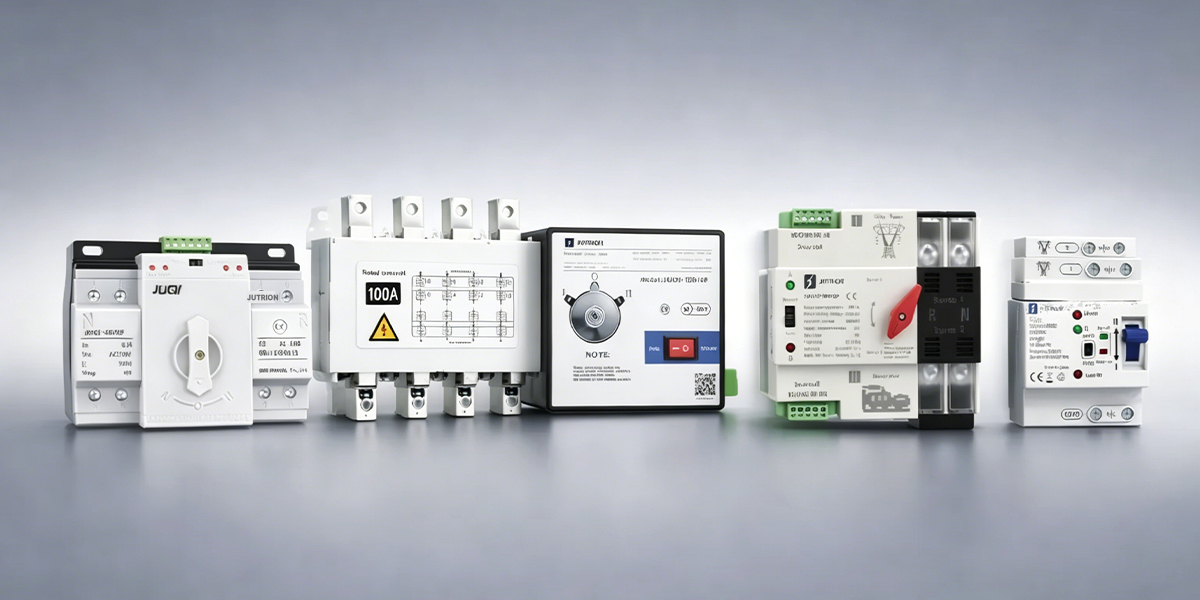
Automatic transfer switches are used for reliable switching between the main power source and backup power source. Our ATS solutions are widely used in generator systems, residential backup power, commercial buildings, and industrial power distribution.
Why Choose JUTRION Automatic Transfer Switches?
 |
|
JUTRION can provide ATS-related services.
Technical Support: For issues related to automatic transfer switch replacement, installation, wiring, and application, we arrange a professional technical team to provide guidance, help customers better understand the product, and offer suitable solutions.
Design and Installation: Our ATS adopts a DIN rail mounting method, allowing fast installation in various distribution cabinets and control systems. The compact modular design helps optimize cabinet layout, reduce occupied space, and make wiring, commissioning, daily maintenance, and later replacement more convenient.
Quality Assurance: Our ATS products comply with IEC standards and can be supported with corresponding certifications according to different product models. Before delivery, JUTRION carries out a series of strict tests, including withstand voltage testing, transfer function testing, control circuit testing, and aging testing, to ensure stable quality and reliable performance.
Cost Advantage: JUTRION products are supplied directly from the factory, which can help customers save up to 30% in cost. The company adopts a one-to-many service model to efficiently respond to customer needs, and with more than 30 automated production lines, it can meet B2B order requirements.
About JUTRION’s OEM Services
JUTRION supports small-batch orders and customized solutions. In addition to product customization, we can also provide customized packaging services. Customer-focused, we are committed to providing suitable solutions for different needs.
Professional Support
Branding and Packaging Customization
Competitive Pricing
IEC Standard Compliance
Flexible Customization
Types of JUTRION Automatic Transfer Switches
JUQ1 PC Class Automatic Transfer Switches:
|
|
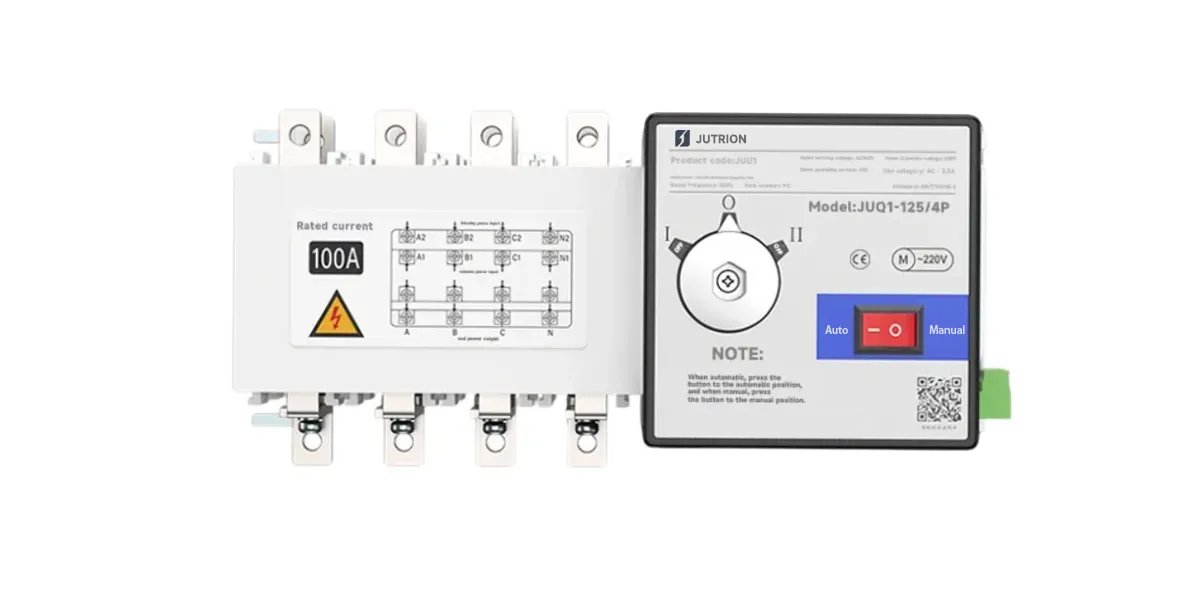
PC Class Automatic Transfer Switch Performance Features
Protection Function: | No overcurrent protection |
Mechanical Life: | High (30,000–100,000 cycles) |
Switching Speed: | ≤0.2s |
Application Scenarios | Critical loads, industrial environments, data centers, generator backup systems |
Cost: | Higher |
JUQ1 CB Class Automatic Transfer Switches:
|
|
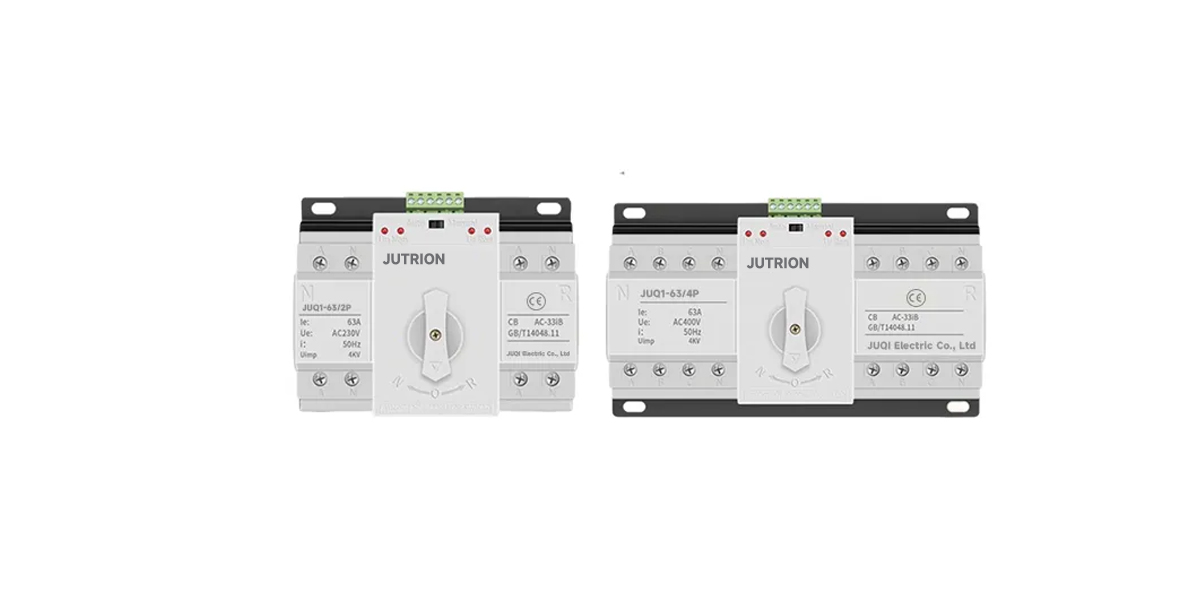
CB Class Automatic Transfer Switch Performance Features
Protection Function: | With overload and short-circuit protection |
Mechanical Life: | Medium (5,000 – 10,000 cycles) |
Switching Speed: | ≤1-3s |
Application Scenarios | Residential distribution systems, commercial buildings, industrial distribution systems |
Cost: | Medium |
JUKG7 Mini Automatic Transfer Switches:
|
|
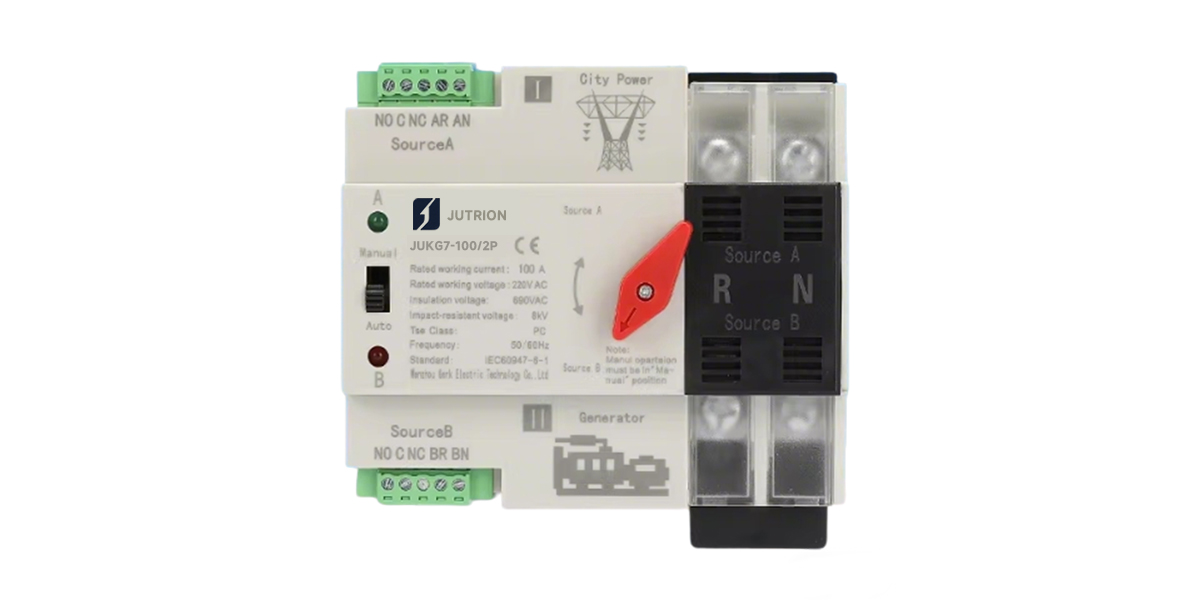
Mini Automatic Transfer Switch Performance Features
Protection Function: | Basic transfer function, requires external protection device if needed |
Mechanical Life: | Medium to High (10,000–30,000 cycles) |
Switching Speed: | ≤0.1s |
Application Scenarios | small power systems,residential backup power,selected photovoltaic applications |
Cost: | Lower |
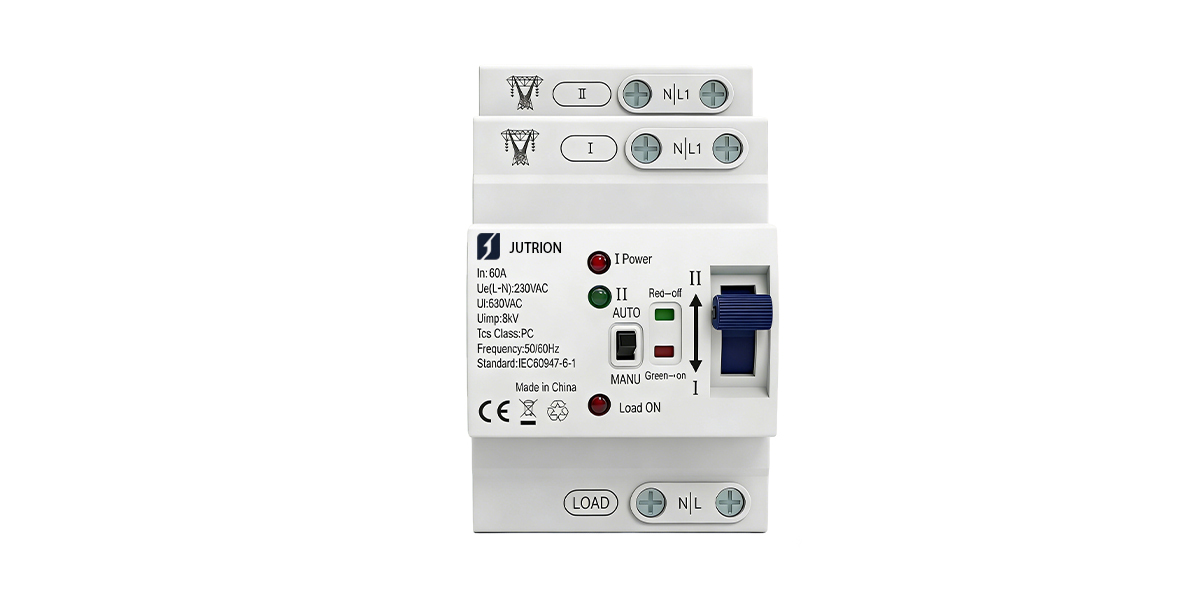
JR2 DIN Rail Automatic Transfer Switches:
 |
|
DIN Rail Automatic Transfer Switch Performance Features
Protection Function: | Basic transfer function |
Mechanical Life: | Medium to High (10,000–30,000 cycles) |
Switching Speed: | ≤0.1s |
Application Scenarios | Residential systems, modular distribution systems |
Cost: | Lower to Medium |
How to Choose the Right ATS: PC Class vs CB Class vs Mini vs DIN Rail?
PC Class ATS : |
|
| CB Class ATS: |
|
| Mini ATS: |
|
| DIN Rail ATS: |
|
How does an Automatic Transfer Switch (ATS) work?
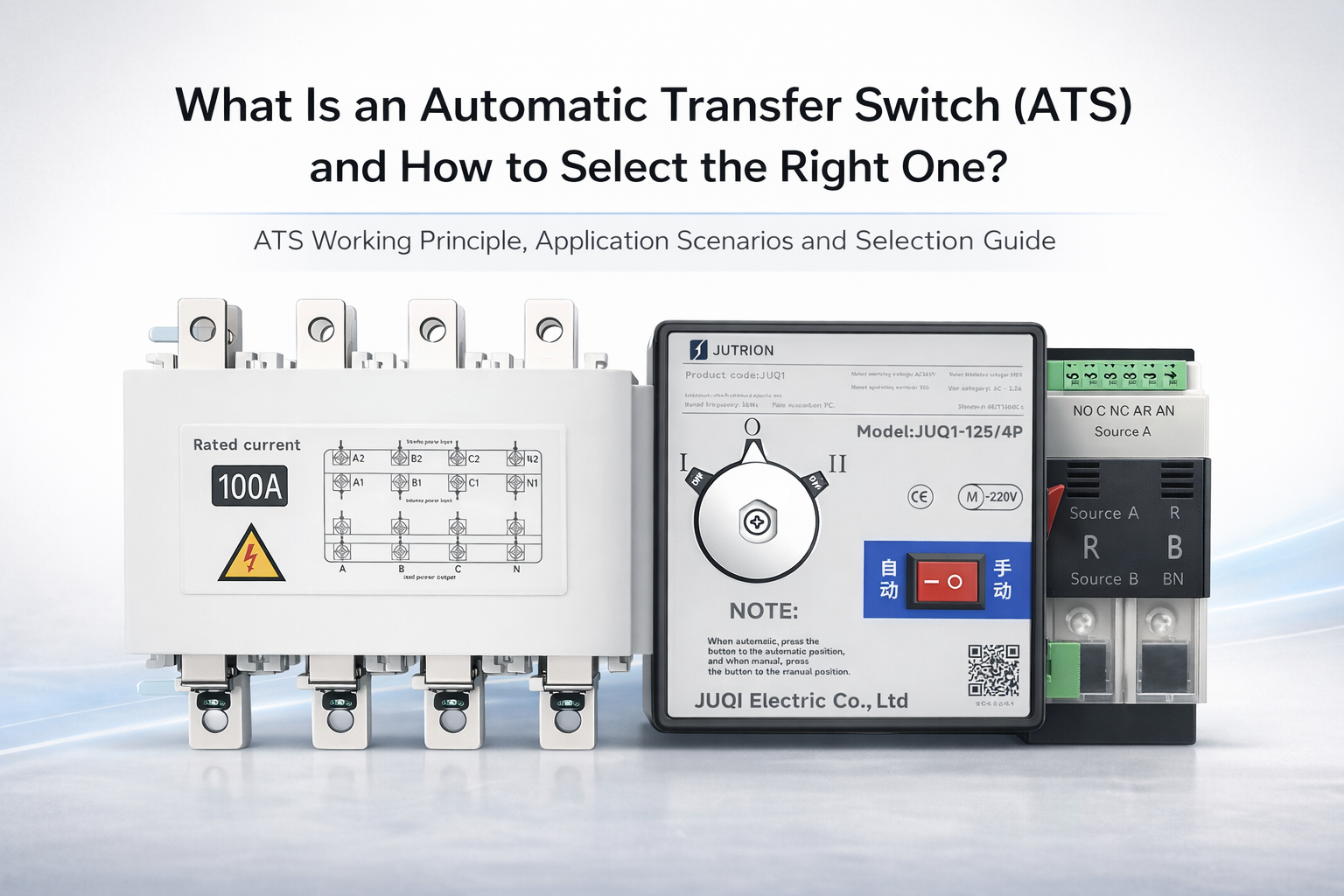
An automatic transfer switch monitors both the main power supply and the backup power supply simultaneously. When the main power fails, experiences phase loss, or abnormal voltage, the switch will automatically disconnect the main power and transfer to the backup power supply. Once the main power returns to normal, the ATS will automatically switch back. The system is equipped with an interlocking mechanism to prevent both power sources from being connected at the same time, avoiding short circuits.
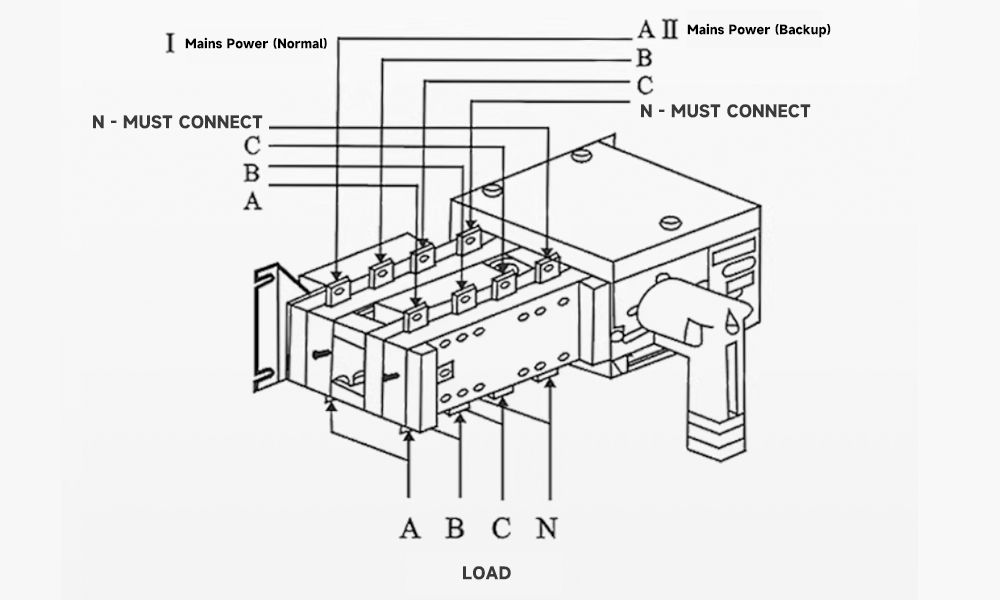
How to wire a dual power automatic transfer switch (4P)?
A 4P PC Class automatic transfer switch is suitable for three-phase four-wire systems. The main power source and backup power source should be connected to the corresponding input terminals of the ATS, while the load should be connected to the output terminals.
Wiring diagram of dual power automatic transfer switch:
|
Applications of ATS in Critical Power Systems
- Commercial Buildings:
ATS ensures the normal operation of key equipment such as elevators, lighting, HVAC systems, and fire protection systems during power outages. When the utility power is interrupted, ATS helps maintain the operation of these critical facilities and ensures personnel safety.
Industrial Automation Systems:
ATS provides stable power supply for PLC control cabinets, motor control centers, conveyor lines, and automated production equipment. This helps reduce production downtime and prevents control systems from being affected by sudden power outages.
Medical Systems:
ATS plays a critical role in these environments, where reliable and continuous power supply is essential. It is commonly used in operating rooms, ICU equipment, ventilators, emergency lighting, and medical monitoring systems to prevent life-threatening situations caused by power outages.
Data Centers:
In a medium-sized data center, ATS can be installed between the utility power and backup generator system. When a power failure occurs, ATS automatically transfers the load to the backup generator or UPS-supported power system, helping prevent data loss, service interruption, and system downtime.
Transportation and Infrastructure:
In traffic control systems, when the main power supply is interrupted, ATS can switch the power supply to a backup source, ensuring that traffic signals, monitoring equipment, and emergency communication systems continue to operate. This is essential for system coordination and public safety.
Common Applications of ATS:
Utility Power + Utility Power (Dual Utility ATS)
In most cases, power outages are caused by single-line faults, maintenance, or tripping, rather than a complete grid failure.
The two power sources are usually supplied by different transformers or substations, so they are unlikely to fail at the same time.
Utility Power + Diesel Generator + ATS
This configuration is designed to handle large-scale or complete power outages, where both utility power sources may fail.
The generator can operate independently and does not rely on the power grid.
Utility Power + Solar Inverter + ATS
When solar energy is available, the system prioritizes solar power. When solar power is insufficient or unavailable, it switches to utility power.
This ensures continuous power supply and improves energy efficiency.
Utility Power + Energy Storage (Battery) + ATS
The battery stores energy and supplies power when the utility power is interrupted. Under normal conditions, utility power is used first.
When a power outage occurs, the system automatically switches to battery discharge. Once utility power is restored, it switches back and recharges the battery simultaneously.
ATS can be flexibly applied in different power supply systems to ensure continuous and reliable power supply under various conditions.
Common Questions About Automatic Transfer Switches (ATS)
Q:What factors should be considered when selecting an ATS?
A:several key factors should be considered, including the application scenario, rated current, number of poles (such as 2P, 3P, or 4P), and switching speed requirements. It is also important to determine whether protection functions are needed, such as overload and short-circuit protection, which may require a CB Class ATS. Installation conditions, such as DIN rail or panel mounting, should also be evaluated. In addition, the compatibility with backup power sources like generators, solar systems, or energy storage should be taken into account. Choosing the right ATS ensures reliable power transfer and stable system operation.
Q:How can the safety of ATS installation be ensured?
A:To ensure safe installation of an ATS, it is essential to follow the product manual and wiring diagram strictly. Installation should be carried out by qualified electricians with proper knowledge of electrical systems. The main and backup power sources must be correctly connected, and phase sequence consistency should be ensured. It is also recommended to install appropriate upstream protection devices such as circuit breakers. Before installation, all power sources must be disconnected to avoid electrical hazards. After installation, testing should be conducted to confirm correct operation. Proper installation helps improve system safety and long-term reliability.
Q:Can ATS be customized according to different requirements?
A:Yes, ATS can be customized according to different application requirements. Manufacturers can provide OEM and ODM services, including customized current ratings, pole configurations, control functions, and external design. In addition, branding and packaging can also be tailored to meet customer needs. For specific projects, ATS can be adapted to different power systems, such as generator backup, solar energy systems, or energy storage applications. Customization helps improve compatibility and performance, making the ATS more suitable for various environments and project requirements.
-
What Is a Surge Protective Device?
2025-10-29 11:05:09 -
How Can a Miniature Circuit Breaker Achieve Remote ON/OFF Control?
2025-12-29 11:05:09 -
How to Select the Right AC Contactor for Electrical Systems?
2026-01-29 20:26:49 -
What Is an Automatic Transfer Switch (ATS) and How to Select the Right One?
2025-11-02 11:05:09 -
Automatic Transfer Switches (ATS) | JUTRION
2026-04-06 12:19:47