


How Much Should an ATS Be Derated at 50°C–60°C Ambient Temperature?
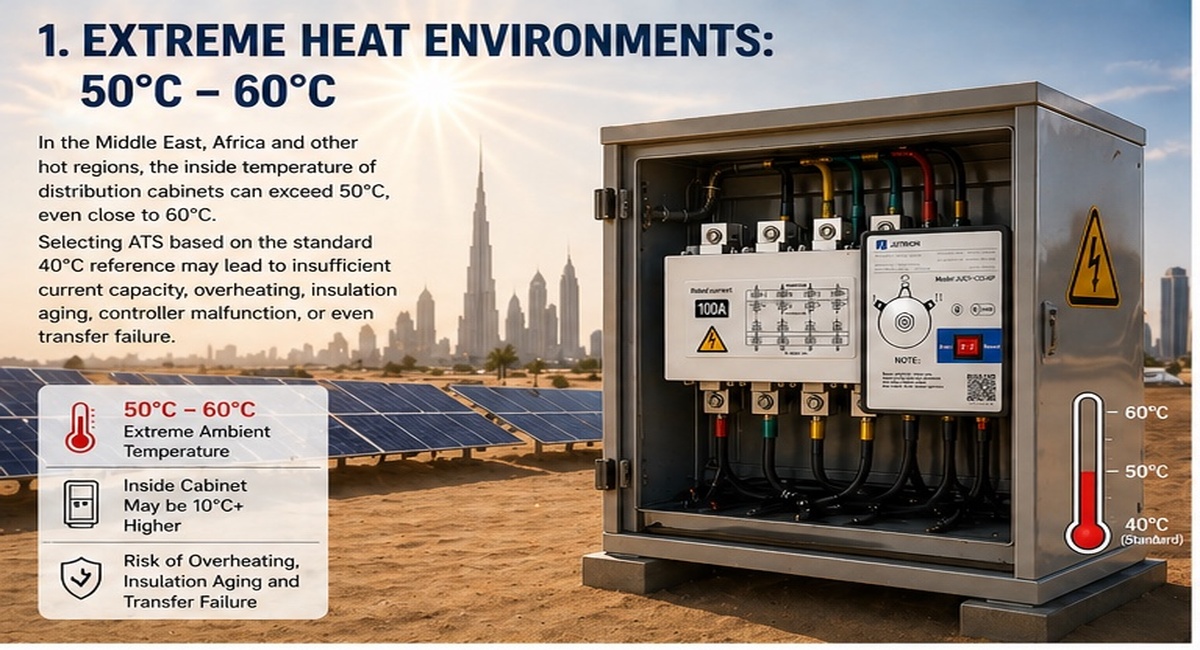
As extreme high-temperature environments become more common, the internal temperature of distribution panels or electrical cabinets in the Middle East, Africa, and other high-temperature regions may exceed 50°C and even approach 60°C. This level of heat is not only a climate challenge, but also a serious test of electrical equipment reliability.
If an automatic transfer switch (ATS) is still selected based on the standard 40°C reference condition, the system may face risks such as insufficient current capacity, contact overheating, insulation aging, controller abnormalities, or even transfer failure.
How to Select the Correct ATS Capacity for Extreme Heat (50°C to 60°C)?
According to the normal service conditions of IEC 60947-6-1, transfer switching equipment is typically suitable for an ambient air temperature not exceeding +40°C, with the average temperature over 24 hours not exceeding +35°C.
However, under extreme summer conditions, outdoor distribution cabinets, electrical panels, and PV combiner boxes are often installed in enclosed spaces with poor ventilation. As a result, the internal temperature may be more than 10°C higher than the outside ambient temperature.
How High Temperature Destroys an ATS System from the Inside?
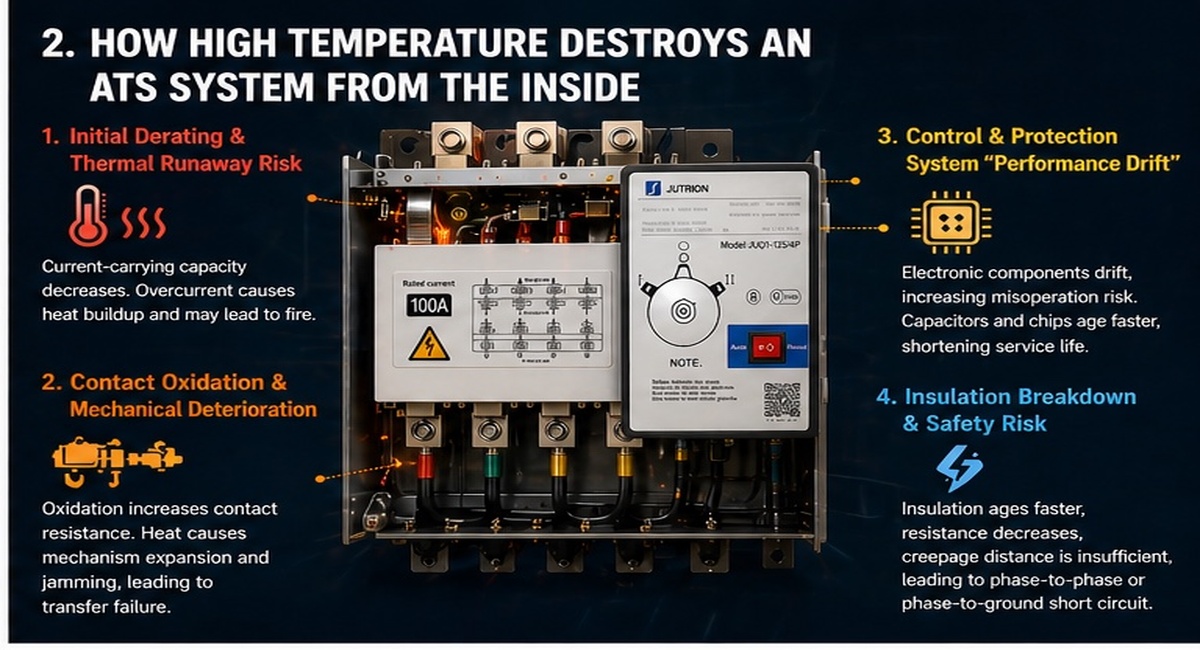
When the ambient temperature exceeds the standard operating range, usually from -5°C to +40°C, the ATS faces not only heat dissipation problems, but also four major reliability threats from the inside out:
Initial Derating and Risk of Thermal Runaway
The necessity of forced derating:
In high-temperature environments, the current-carrying capacity of the ATS must be physically derated. For example, if a device is rated at 100A at 40°C, when the ambient temperature rises to 50°C, its safe current-carrying capacity may drop to 80A.
Hidden danger of thermal runaway:
If the downstream load is not reduced at the same time, the actual current will exceed the real-time carrying limit of the device, causing heat to build up rapidly and creating a fire risk.
Contact Oxidation and Mechanical Mechanism Deterioration
Contact performance damage:
When the internal temperature exceeds 60°C, the plating layer on the contact surface will accelerate oxidation and sulfidation. This will cause the contact resistance to increase abnormally. In serious cases, it may lead to contact welding or severe arc burning.
Mechanical mechanism jamming:
Key mechanical parts such as springs and rotating shafts may expand due to heat, while the material strength decreases accordingly. This can cause delayed movement or jamming of the switching mechanism, eventually causing the system to fail to complete power transfer at a critical moment.
“Performance Drift” of the Control and Protection System
Electronic component instability:
Precision components on the controller, relays, and PCB board may experience performance drift under high temperatures.
Risk of false operation:
Due to reduced sampling accuracy of voltage and frequency, the controller may misjudge the power supply status, causing the system to switch frequently or meaninglessly back and forth.
Exponential reduction in service life:
The service life of electrolytic capacitors and microchips will decrease exponentially under high temperatures. This often causes the overtemperature or undervoltage protection functions to fail completely when they are needed most.
Insulation Performance Breakdown and Safety Risks
High temperature accelerates the aging of insulating materials, reduces insulation resistance, and causes insufficient creepage distance, which can easily lead to phase-to-phase or phase-to-ground short circuits.
Recommendations for Handling the Key Effects of High Temperature on ATS
How to Select the Right Model:
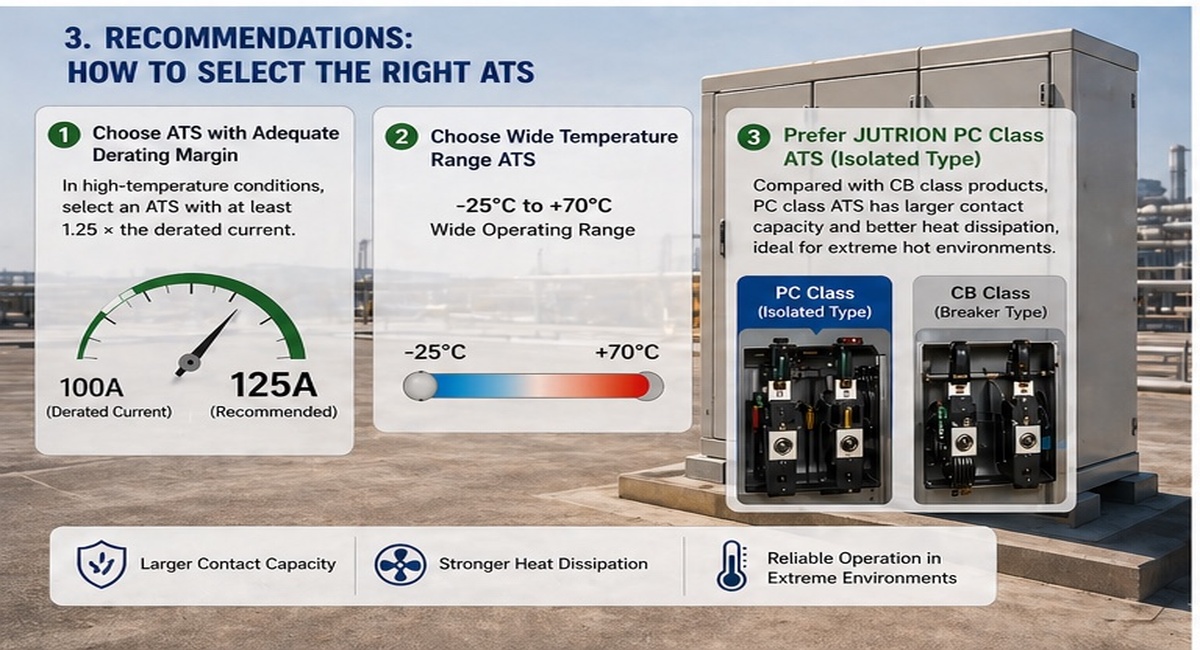
In high-temperature conditions, it is recommended to select an ATS with a current rating at least 1.25 times higher than the derated current requirement.
Choose a wide-temperature ATS, suitable for -25°C to +70°C operation.
Give priority to JUTRION PC-class ATS products. Compared with CB-class products, PC-class ATS has higher contact capacity and stronger heat dissipation performance, making it more suitable for extreme hot environments such as the Middle East.
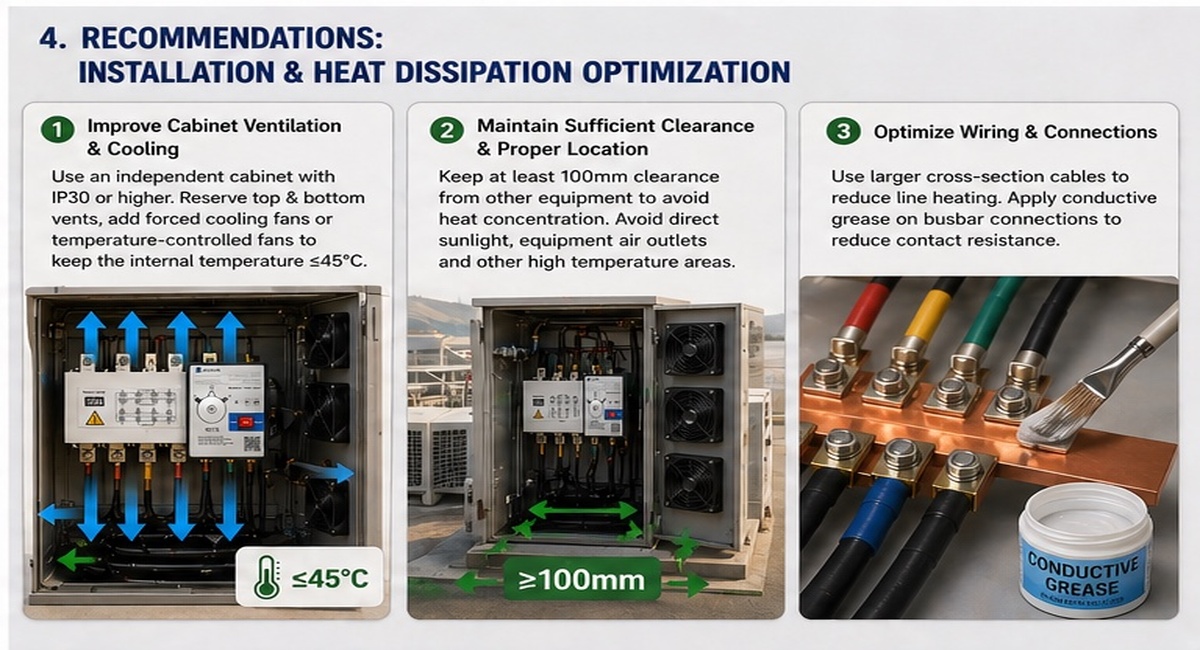
Installation and Heat Dissipation Optimization(ATS):
Use an independent cabinet with an IP30 or higher protection rating. Reserve upper and lower ventilation openings, and add forced cooling fans or temperature-controlled fans to keep the cabinet internal temperature below 45°C.
Keep at least 100 mm of spacing between the ATS and other equipment to avoid heat concentration. The installation position should avoid direct sunlight, equipment air outlets, and other high-temperature areas.
Use cables with a larger cross-sectional area to reduce line heating. Apply conductive paste on copper busbar connections to reduce contact resistance.
Why is a PC-class ATS better than a CB-class ATS in new energy projects and PV combiner boxes?
A PC-class ATS is an isolation-type transfer switch with larger contact capacity. Even when high temperature accelerates oxidation of the silver-plated contact layer, it can still maintain lower contact resistance.
The structural design of a PC-class ATS is also more suitable for high-current heat dissipation. Compared with a CB-class ATS with built-in circuit breaker protection, a PC-class ATS has better thermal stability in 50°C–60°C environments.
If my load is an inductive load, such as an air conditioner or pump, what selection ratio should I use under high-temperature conditions?
First, physical derating should be applied according to the ambient temperature. For example, the safe current-carrying capacity of a 100A device at 50°C may only be 80A.
For inductive loads with frequent starts, it is recommended to reserve an additional current margin of 1.25 times based on the derated current.
Conclusion:
As extreme weather conditions become increasingly common, proper derating and ATS selection are not only important for passing project acceptance, but also essential for ensuring the long-term safety of the power system. If you are facing selection challenges for a specific high-temperature project, please contact us to obtain more accurate derating curve data.
-
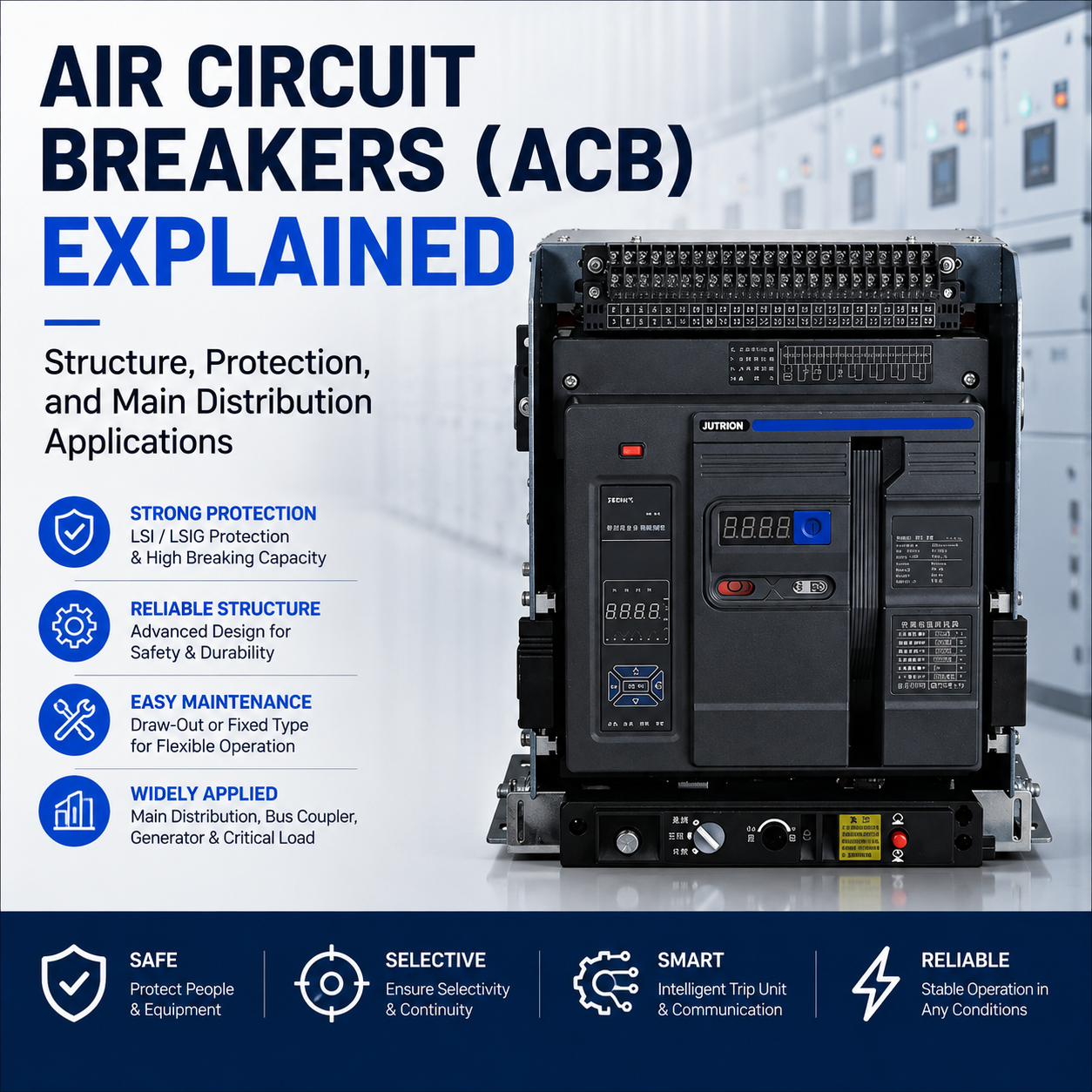
Air Circuit Breakers (ACB) Explained: Structure, Protection, and Main Distribution Applications
2026-05-24 22:21:27 -
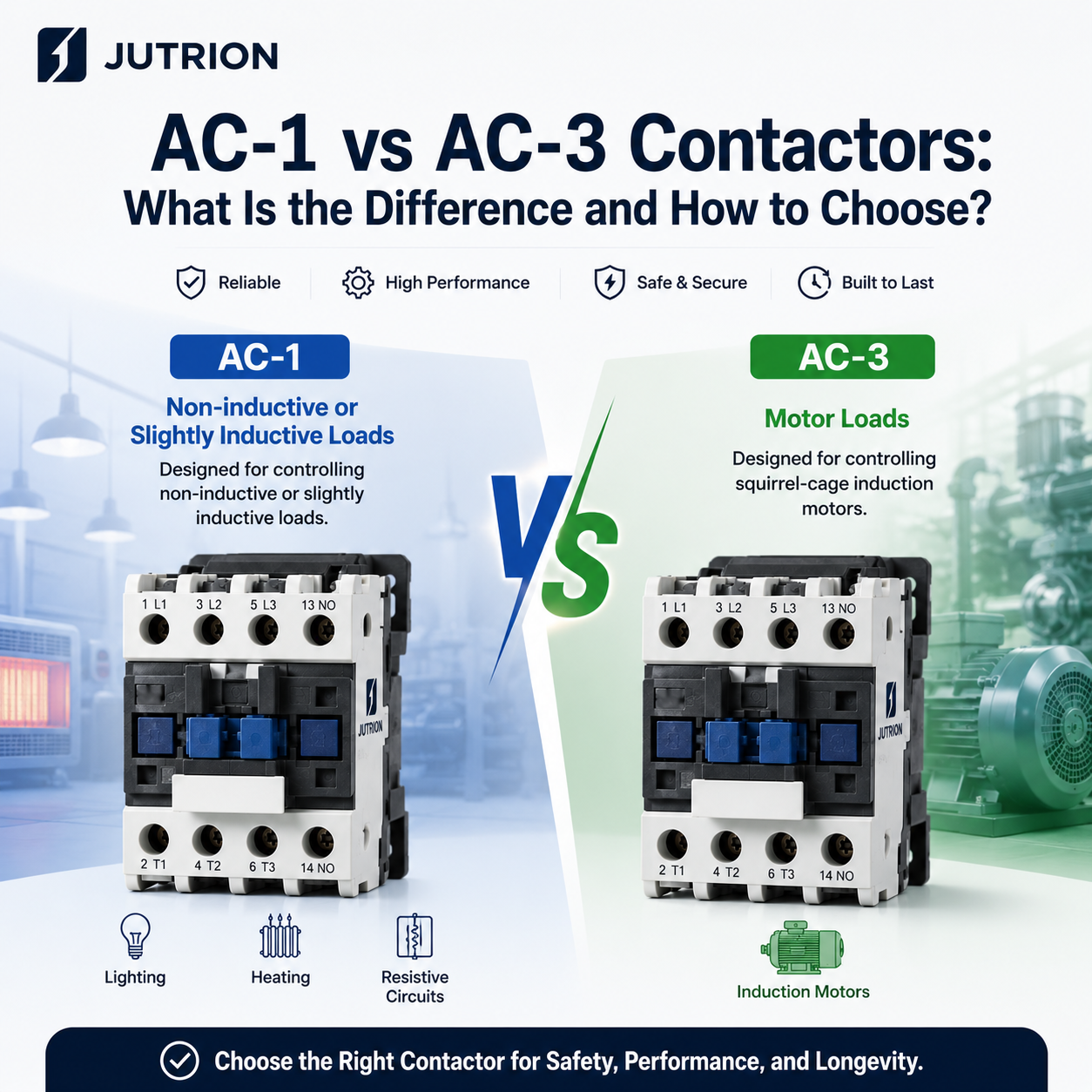
AC-1 vs AC-3 Contactors: What Is the Difference and How to Choose?
2026-05-20 19:31:24 -
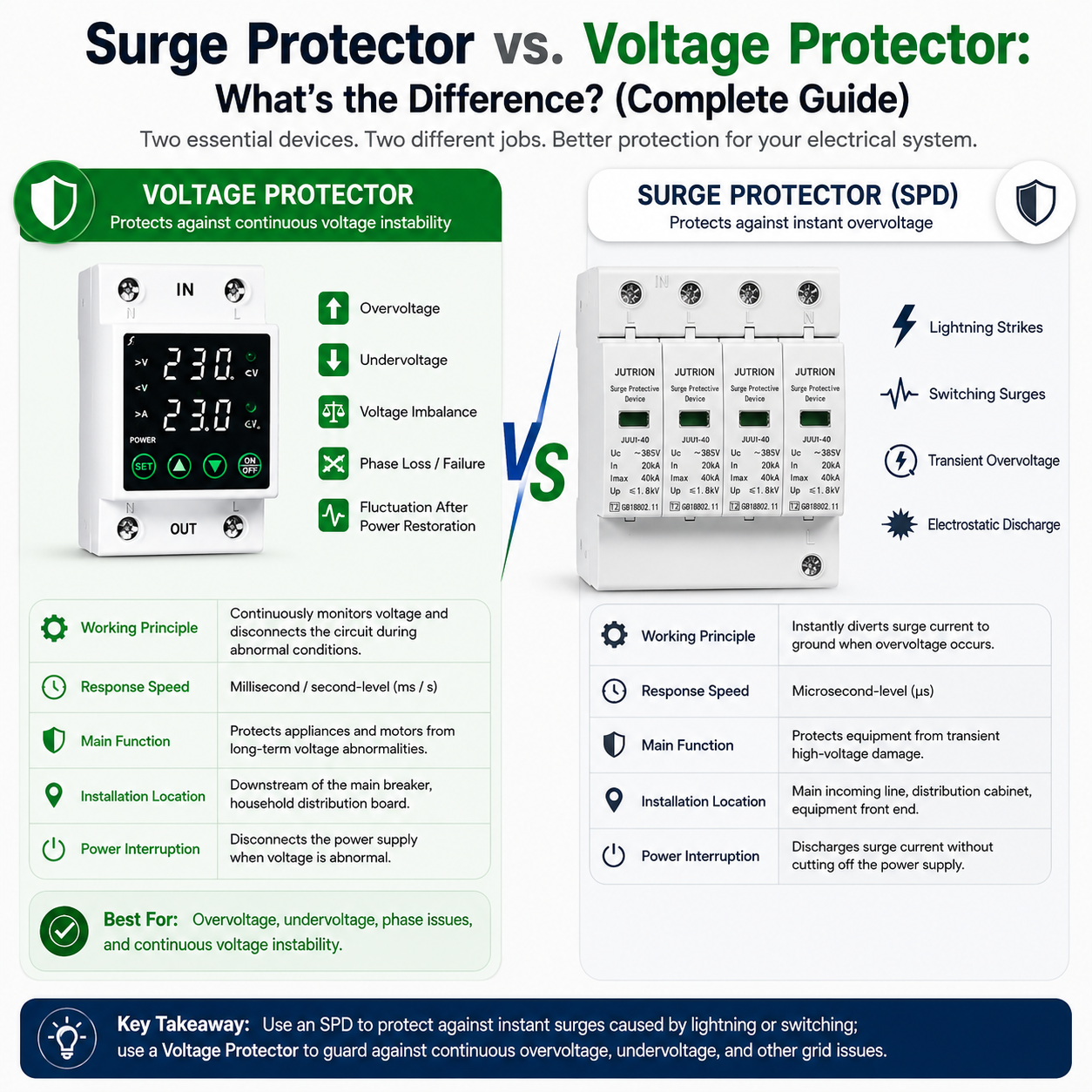
Surge Protector vs. Voltage Protector: What’s the Difference? (Complete Guide)
2026-05-18 17:50:53 -
Selection and Installation Guide for SPDs in Solar PV Systems
2026-05-16 12:54:43 -
Voltage Stabilizer vs. Over and Under Voltage Protector: What Is the Difference?
2026-05-14 14:37:10