



What Is the Difference Between 2P AFDD and 1P+N AFDD?
Why Is AFDD Important for Modern Electrical Safety?
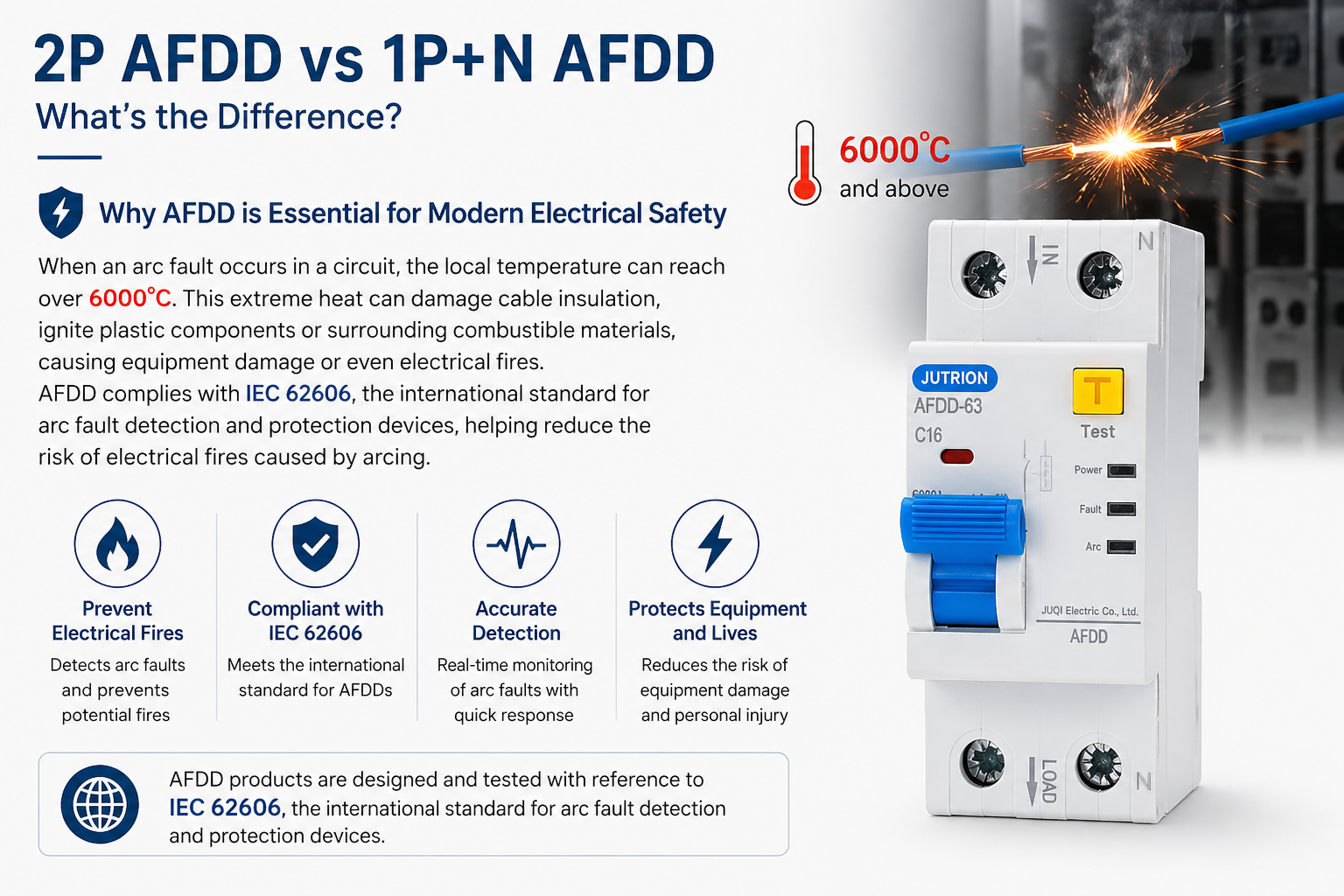
When an arc fault occurs in an electrical circuit, the local temperature generated by the arc can reach over 6000°C. This extreme heat may damage the cable insulation layer and may ignite plastic components inside the distribution box or surrounding combustible materials, eventually causing circuit damage, equipment burnout, or even electrical fire. AFDD complies with the IEC 62606 international standard and is specially designed to identify arc faults, helping reduce the risk of electrical fires caused by arcing.
2P AFDD VS 1P+N AFDD
2P AFDD Parameter Features
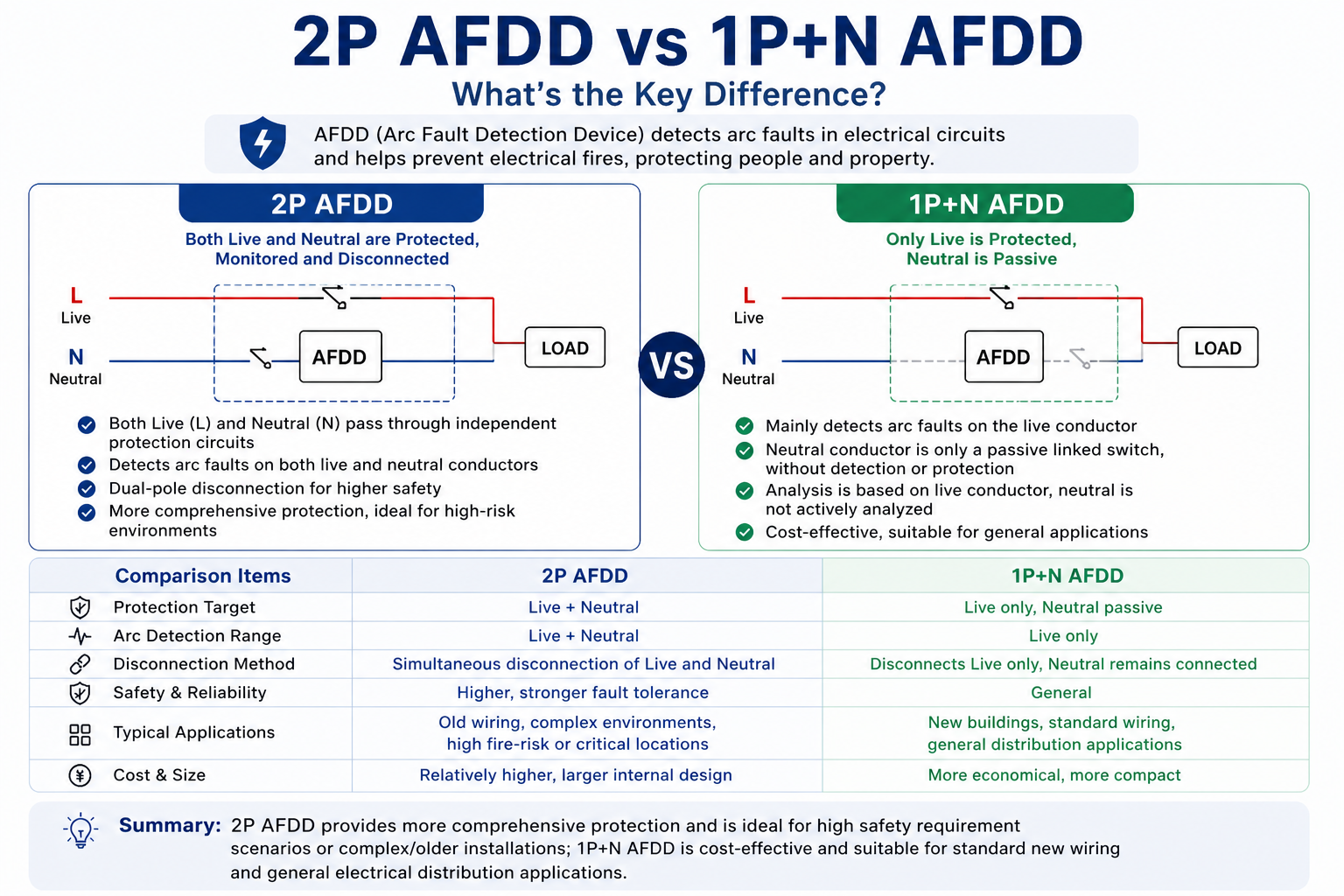
Both live and neutral conductors have independent protection circuits. The live and neutral conductors can both be sampled, monitored for arc faults, and tripped for overcurrent protection.
If the neutral wire terminal becomes oxidized, loose, arcing, or aged, a 2P AFDD has a better chance of identifying this abnormal risk, making it suitable for applications with higher safety requirements.
1P+N AFDD Parameter Features
A 1P+N AFDD usually uses the live conductor L as the main protected pole, responsible for arc detection, overcurrent tripping, and fault judgment.
A 1P+N AFDD is mainly used to detect arc faults on the live conductor side. For neutral wire problems such as loose terminals, oxidation, or arcing, its detection capability is usually not as complete as that of a 2P AFDD.
For specific AFDD parameters, please refer to JUTRION AFDD-63.
Core Difference Between 2P AFDD and 1P+N AFDD
For a 2P AFDD, both the live conductor and the neutral conductor pass through independent protection circuits and can be sampled at the same time. It is suitable for applications with higher safety requirements. A 1P+N AFDD usually uses the live conductor as the main protected pole and mainly detects arc faults on the live side. It is more suitable for ordinary single-phase distribution circuits. Overall, 1P+N AFDD is more economical and practical, while 2P AFDD provides more complete protection.
How to Choose Between 1P+N AFDD and 2P AFDD According to the Application Scenario?
Application Scenarios for 1P+N AFDD
New residential buildings and fully fitted apartment distribution systems, In this scenario, the wiring is new, the installation is standardized, and the neutral wire is strictly fixed and not frequently changed. Live-side arc protection is usually enough, and there is no obvious neutral wire fault risk.
- New office buildings and standard office circuits,The overall wiring is unified, the installation process is standardized, later modifications are limited, the load is simple and stable, and reverse connection of live and neutral wires is unlikely.
Supporting rooms in industrial parks, guard rooms, and small auxiliary buildings,These applications have simple working conditions, fewer complex hidden risks, small loads, simple circuits, and little change after one-time wiring installation.
In the above scenarios, the risk of arc faults, overload, or poor contact on the neutral wire is extremely low. Live-side arc protection is usually enough to meet basic national fire protection requirements. Choosing a 1P+N AFDD can provide basic safety protection while controlling cost and improving adaptability for batch projects, offering the best cost performance.
Application Scenarios for 2P AFDD
Old residential communities and old wiring renovation projects,In old wiring systems, the neutral wire may be aging, and there may be many connection points that are more likely to become loose or cause arcing. A 1P+N AFDD may not fully detect neutral-side arc faults, while a 2P AFDD provides more complete protection.
Temporary construction power,Temporary construction power often involves frequent dismantling, rewiring, and irregular connections. A 2P AFDD has higher fault tolerance and stronger safety.
Rental apartments, homestays, and shared housing buildings,These applications often have complicated electricity usage, mixed high-power appliances, frequent plug-in loads, large long-term circuit fluctuations, widespread informal wiring modifications, and more hidden risks. Dual live-neutral arc protection is recommended.
Flammable storage areas and high fire-safety locations,For locations requiring the highest level of fire protection, arc fault coverage on both the live and neutral conductors is required to reduce hidden fire risks as much as possible.
In the above scenarios, the neutral wire may also have hidden risks such as arc faults, overload, and poor contact. A 1P+N AFDD mainly protects the live conductor and may have obvious protection blind spots. A 2P AFDD provides dual live-neutral disconnection and protection, can monitor arc faults on both the live and neutral conductors at the same time, and offers stronger fault tolerance even if live and neutral wires are reversed.
2P AFDD and 1P+N AFDD Troubleshooting Guide
When a 2P AFDD trips:First, disconnect the power supply and check the live and neutral wire connections and tighten the terminals. Then disconnect the load section by section to check the line insulation. Distinguish between harmonic interference, line faults, and damage to the internal protection circuit of the device. Confirm whether neutral-side arcing or overload can still trigger tripping normally.
When a 1P+N AFDD trips:First, disconnect the power supply and strictly check whether the live and neutral wires are reversed. Then disconnect the load and check the live conductor insulation and terminals. If the neutral wire is heating or arcing but the device does not trip, this is a protection blind spot. After eliminating line faults and harmonic interference, if it still trips, replace the device directly.
FAQs:
Q: Why is 1P+N AFDD cheaper? Can it be used in critical circuits?
A:1P+N AFDD only provides arc detection, overcurrent tripping, arc extinguishing chamber, and other complete protection components on the live conductor side. The neutral conductor is only a passive linked switch, without any detection or protection circuit. In standard wiring applications, the neutral wire rarely has problems, so protecting the live conductor is usually enough.
Q:How can I know whether the AFDD tripped because of an arc fault or ordinary overcurrent?
A:When tripping is caused by an arc fault, such as poor contact and arcing, the indicator on the panel usually flashes at a specific frequency. When tripping is caused by an ordinary short circuit, the indicator status is usually different. This distinction can greatly reduce the time electricians spend troubleshooting the circuit fault.
Q: Is there a big size difference between 2P AFDD and 1P+N AFDD?
A:Due to market demand and to make replacement easier for users, JUTRION has designed both products with the same width of 36 mm.
Q: What is the most common installation mistake for 1P+N AFDD?
A:For a 1P+N AFDD, the live conductor (L) and neutral conductor (N) must be strictly distinguished, because its protection logic mainly focuses on the live conductor side. If live and neutral are reversed, the protection mechanism may fail.
-
What Is a Surge Protective Device?
2025-10-29 11:05:09 -
How Can a Miniature Circuit Breaker Achieve Remote ON/OFF Control?
2025-12-29 11:05:09 -
How to Select the Right AC Contactor for Electrical Systems?
2026-01-29 20:26:49 -
What Is an Automatic Transfer Switch (ATS) and How to Select the Right One?
2025-11-02 11:05:09 -
What Is the Difference Between 2P AFDD and 1P+N AFDD?
2026-05-01 15:09:49